
From Chauffeur to Dodge Dealer
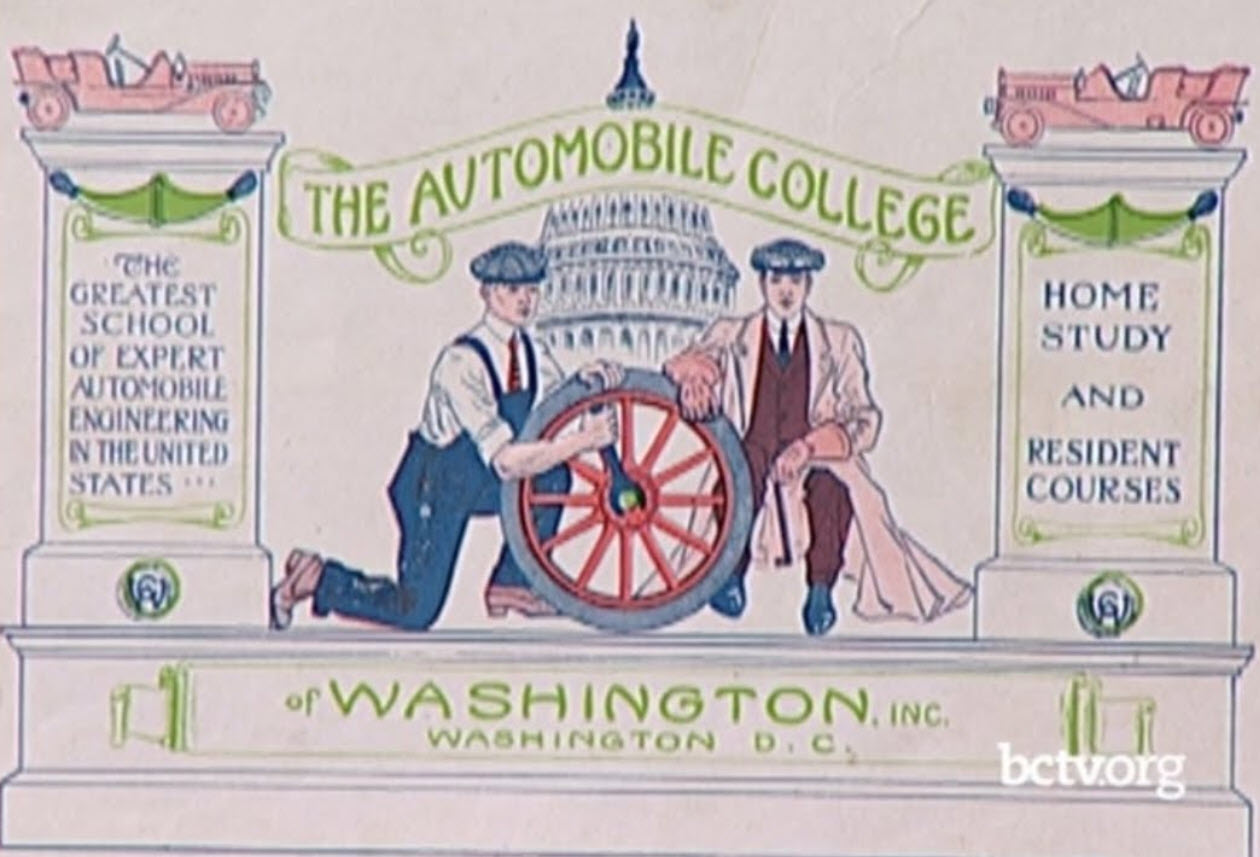 In the early 1900s, owning an automobile was a luxury few could afford, and operating one was no simple task. Early cars were finicky machines that required constant attention and mechanical knowledge. This gave rise to a unique profession: the chauffeur-mechanic. To meet the growing demand for this specialized role, schools began offering technical training in automobile operation and repair. One such institution was The Automobile College of Washington, founded in 1909 in Washington, D.C. Given the timing and location, it is likely that Lewis Reed received his early chauffeur and mechanical training at this institution, a step that helped pave the way for his later work with prominent manufacturers. In addition to the Automobile College of Washington, Lewis Reed received automotive training at the Pierce-Arrow factory in Buffalo, New York and the Dodge Hamtramck and Hudson Motor Car factories in Detroit, Michigan.
The school featured a fully equipped repair department and machine shop, complete with modern engines for hands-on learning. Students were trained on a variety of vehicles, including the Washington A-1 Touring Car, Pope Tribune, Peerless 35hp, Ricketts Model G 6-cylinder, and Mitchell 25hp, giving them practical experience with some of the era’s most advanced technology.
According to the 1910 census, 23-year-old Lewis Reed was employed as a machinist. Coming from a blacksmithing family background, he was already familiar with tools and machinery. As the automobile industry gained momentum, his mechanical aptitude made the transition to working with cars a natural one.

Two ladies with parasols are sitting in the landaulet section of an early Pierce-Arrow limousine, while chauffeur Lewis Reed tends to the motor. The rear portion of the limousine is partitioned from the driver with a glass shield, and covered by a convertible top, which you can see is currently in the lowered position behind the ladies. Photo taken circa 1910.
Early cars were temperamental, mechanically complex, and prone to breakdowns. As a result, the job of a chauffeur demanded not only driving ability but also technical knowledge. Their duties went beyond transportation; they were responsible for keeping the car running smoothly, diagnosing problems on the road, and performing regular upkeep. The role was seen as a respectable and skilled profession that required formal training.
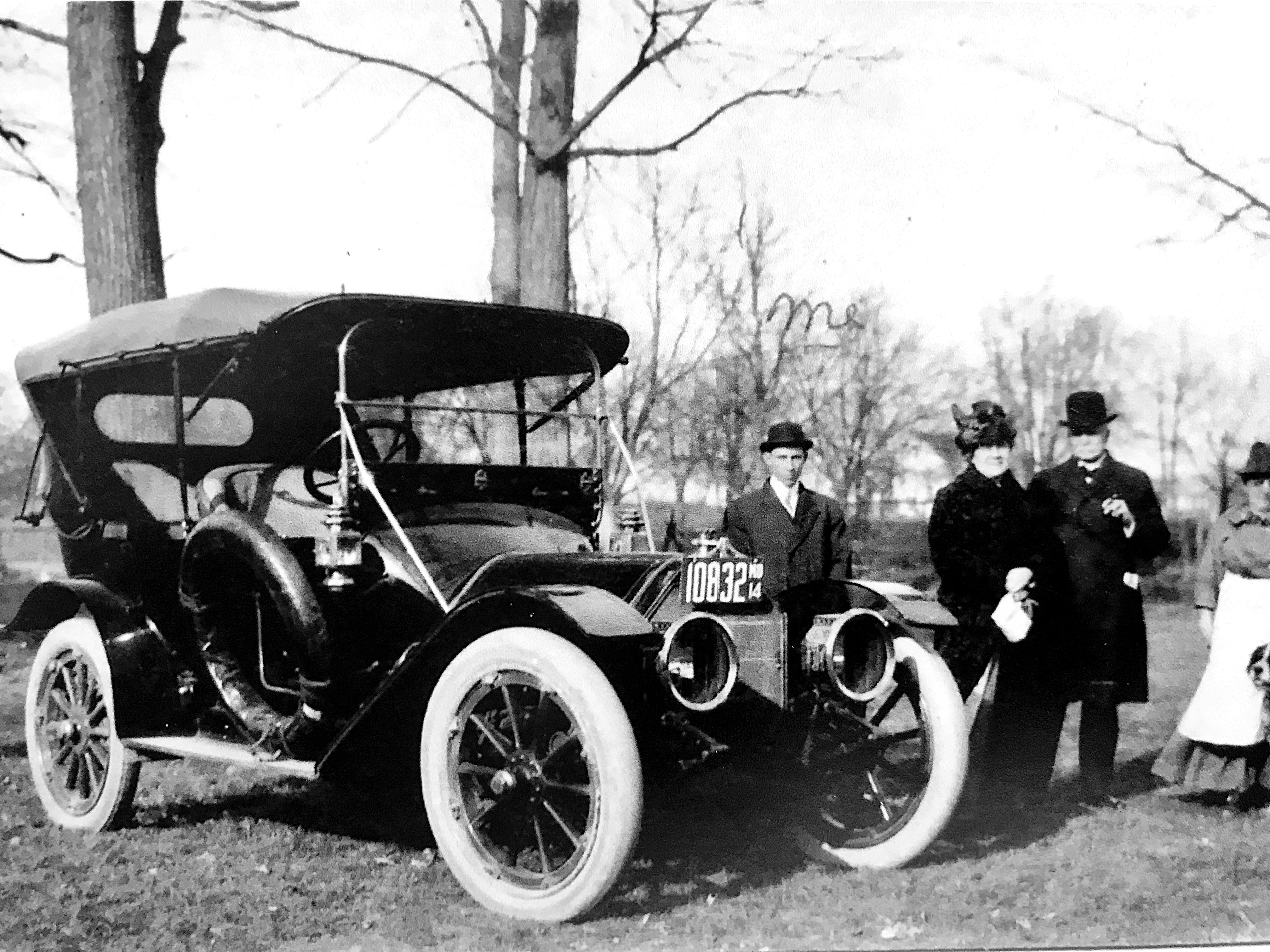
Chauffeur Lewis Reed (left) with unidentified family, 1914
Lewis Reed’s experience behind the wheel, and under the hood, lasted until about 1914, when he transitioned into the business of selling and repairing cars. The above image captures Lewis at a pivotal moment in his life, just before he transitioned from being a chauffeur-mechanic to becoming an automobile dealer. His time in this role not only reflects the expectations of early chauffeurs but also laid the groundwork for what would become a lifelong career in the auto industry.
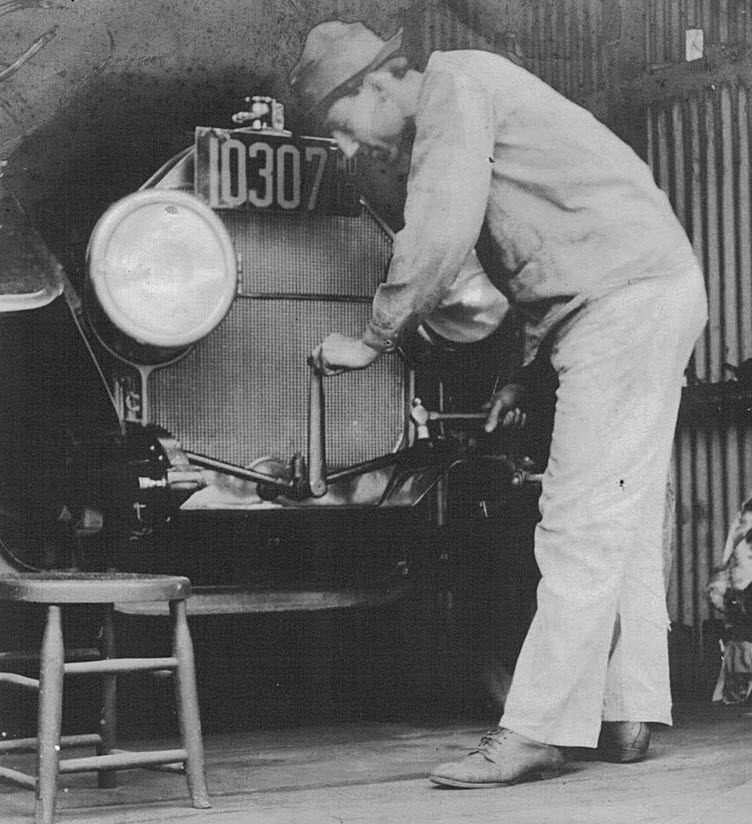
Lewis Reed hand cranking an old car. The hammer in Lewis Reed’s right hand is for straightening the hand crank. Apparently they can bend when starting big engines. The license plate is MD 10307 dated 1913.
The chauffeur-mechanic profession eventually faded as cars became more reliable and easier to operate. Lewis Reed’s experience as a chauffeur-mechanic in the early 1900s was more than just a job; it was the foundation of a lifelong career in the automobile industry. At a time when cars were still a novelty and required hands-on expertise, Reed’s skills and mechanical knowledge set him apart. His early years behind the wheel and under the hood gave him a unique understanding of the vehicles he would one day sell and service as a dealer.
The Automobile College of Washington

From the August 11, 1909 issue of The Horseless Age Magazine (Google Books)
In addition to the Pierce-Arrow factory in Buffalo, New York and the Dodge Hamtramck and Hudson Motor Car factories in Detroit, Michigan, Lewis Reed received automotive training at The Automobile College of Washington.
The Automobile College of Washington was organized in 1909 for the purpose of training young men to fill positions as automobile engineers. The school had a repair department and a machine shop with modern motors for demonstration, where each student was taught in the mechanical construction, use, operation, and repair of the very latest four-cylinder automobiles. Some of the cars used in the school were the Washington A-1 Touring Car, Pope Tribune, Ricketts Model G 6-cylinder, Peerless 35hp, and Mitchell 25hp.
The November 7, 1909 edition of The Washington Times announced that the school was the pioneer institution of its kind in the city. Young men without previous experience were taught to be chauffeurs to not only drive, but also maintain and repair the automobiles. The Automobile College of Washington was more than likely the institution where Lewis Reed received his chauffeur training.

The Evening Star, November 07, 1909
Books

Related Resources


Copyright Notice

Reed Brothers Dodge History (1915-2012) by Jeanne Gartner is licensed under a Creative Commons Attribution-NonCommercial 3.0 Unported License.
 Reed Brothers Dodge History 1915 – 2012
Recent Comments