
Fisk Tires
Reed Brothers was founded and franchised as a Dodge dealership in 1915; only one year after the first Dodge automobile was made. Initially, Reed Brothers sold Oldsmobile and Hudson, along with Dodge. Reed Brothers was a successful company, combining car sales, auto accessories and repair service. They also sold Fisk Tires which were made in Chicopee Falls, Massachusetts.
After seeing the Fisk Tire signs in the photos below, I was curious to learn more about the company and the tires that they made. The history of the Fisk Tire Company is relatively obscure, but as far as is known, Noyes W. Fisk purchased a failing rubber manufacturing company in 1898. Fisk continued the company under his own name and branched out to sell automobile tires. By 1904, most of the country’s major car manufacturers were buying Fisk tires. The tire business, along with many other businesses, fell upon hard times during the great depression. Despite all the country’s hardships, Fisk survived and introduced its new Safti-Flight tire in 1930, and it proved to be an impressive success. (click images to enlarge)
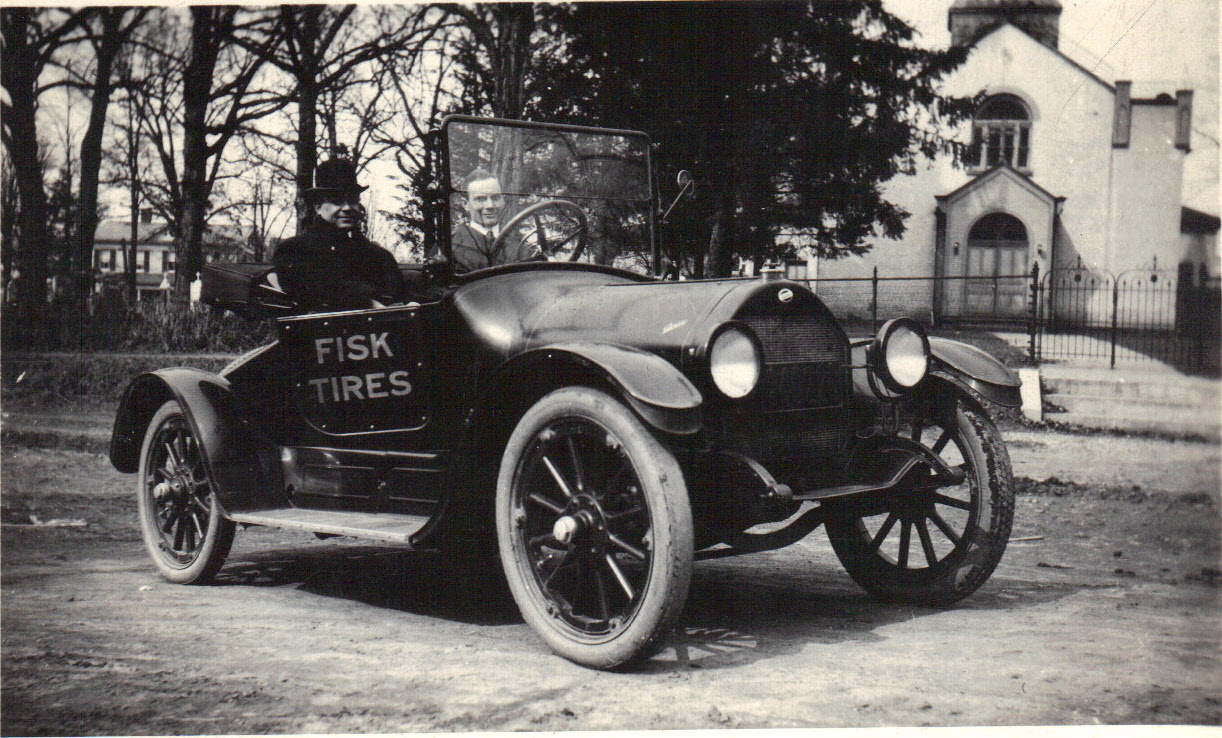
This photo was taken by Lewis Reed across from Reed Brothers Dodge, circa 1915. Old St Mary’s Church is in the background.
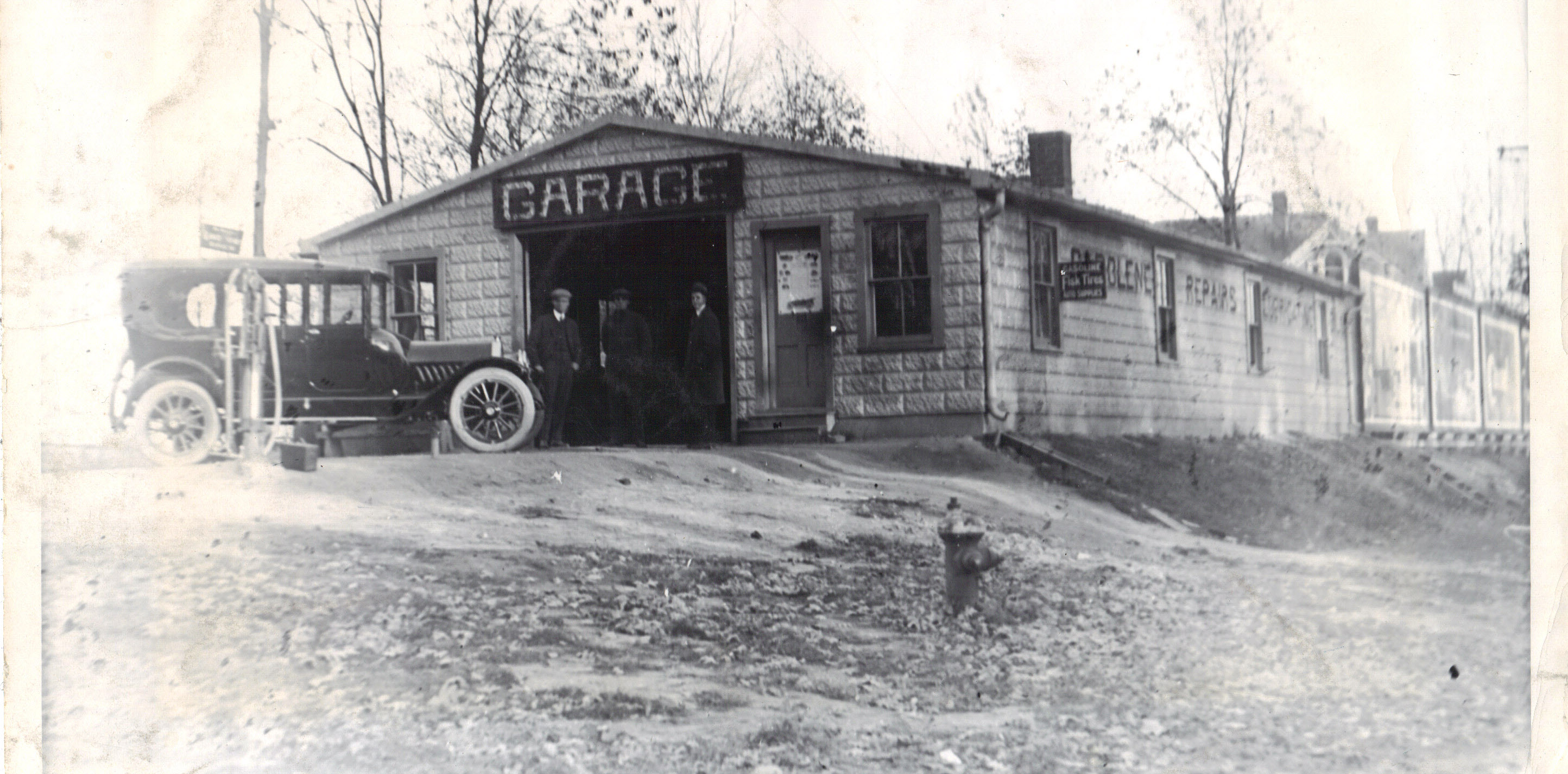
Original 1915 Rockville Garage located at the intersection of Veirs Mill Road and Rockville Pike. The small sign on the right side of the Garage advertises Gasoline, Fisk Tires and Supplies.
Below is an ad I found in the September 18, 1915 edition of Automobile Topics that gives you an idea of the cost of tires at the time, which was considerable.


Source: Chicopee (Google eBook)
Featured Photo: Hand-Cranked Car
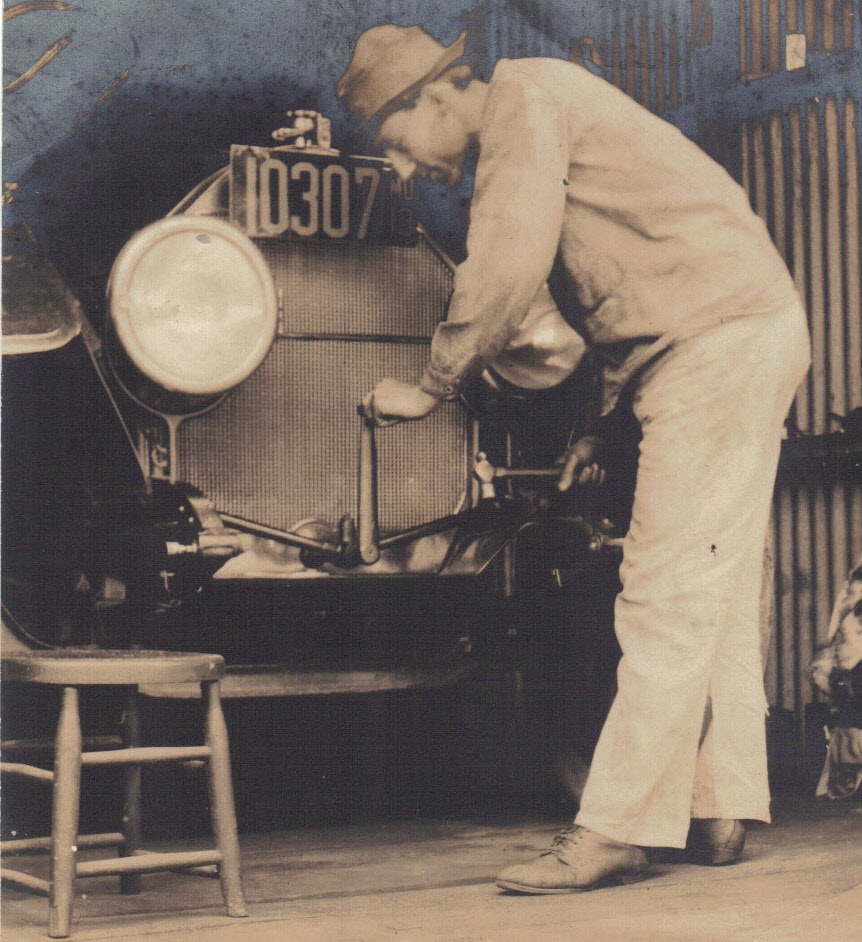
Lewis Reed hand cranking an old car. The license plate is MD 10307 dated 1913.
Today, we take the starting of automobiles for granted. Simply place the key in the ignition, turn, and VROOM, the engine starts.
However, this was not always the case. Cars in the early parts of the century had to be started by hand. This was accomplished by turning a crank, usually located in the front of the automobile. When the crank was turned, it moved the pistons in the automobile’s engine until enough momentum was built up to keep the engine going on its own. Hand cranking was also physically demanding making it very difficult for anyone with a small stature to start the engine.
By 1920, nearly all manufacturers were producing cars equipped with starters making it easy for anyone, regardless of physical abilities, to start a car by pressing a button mounted on the dash or floor. An ignition on and starter engage switch operated by a key was introduced by Chrysler in 1949.
Reed Brothers Texaco Filling Station
The 1917 photo below is the Reed Brothers original Rockville Garage located at the intersection of Veirs Mill Road and Rockville Pike. To the right is a Texaco Gasoline Filling Station sign. One very tall Texaco branded fuel pump can be seen in this photo along with two Texaco Petroleum refueling trucks. The gas pump globe on the top advertizes the gas company name and logo. Parked in front is a line-up of some very early Dodge Brothers Motor Vehicles.
Also visible in the photo are trolley tracks that went along Rockville Pike and Montgomery Avenue to Laird Street and back again. From 1900 – 1935, the trolley cars went past Reed Brothers Dodge as they traveled up Rockville Pike.
At some point between prior to 1920, Reed Brothers Dodge changed over from selling Texaco and became a Gulf Gasoline dealer. Reed Brothers had the first Gulf gas station in the still-rural Washington D.C. area. (click on images to enlarge)

1917 Original Rockville Garage with 2 story addition. Note the Texaco Filling Station signage and the Texaco Petroleum fuel truck refilling the single pump in front.
Below, a Texaco Petroleum tanker is delivering its load of fuel to Reed Brothers in this circa 1917 photo. The delivery driver seems to be wearing his best suit on this job, something that you don’t see these days at all.
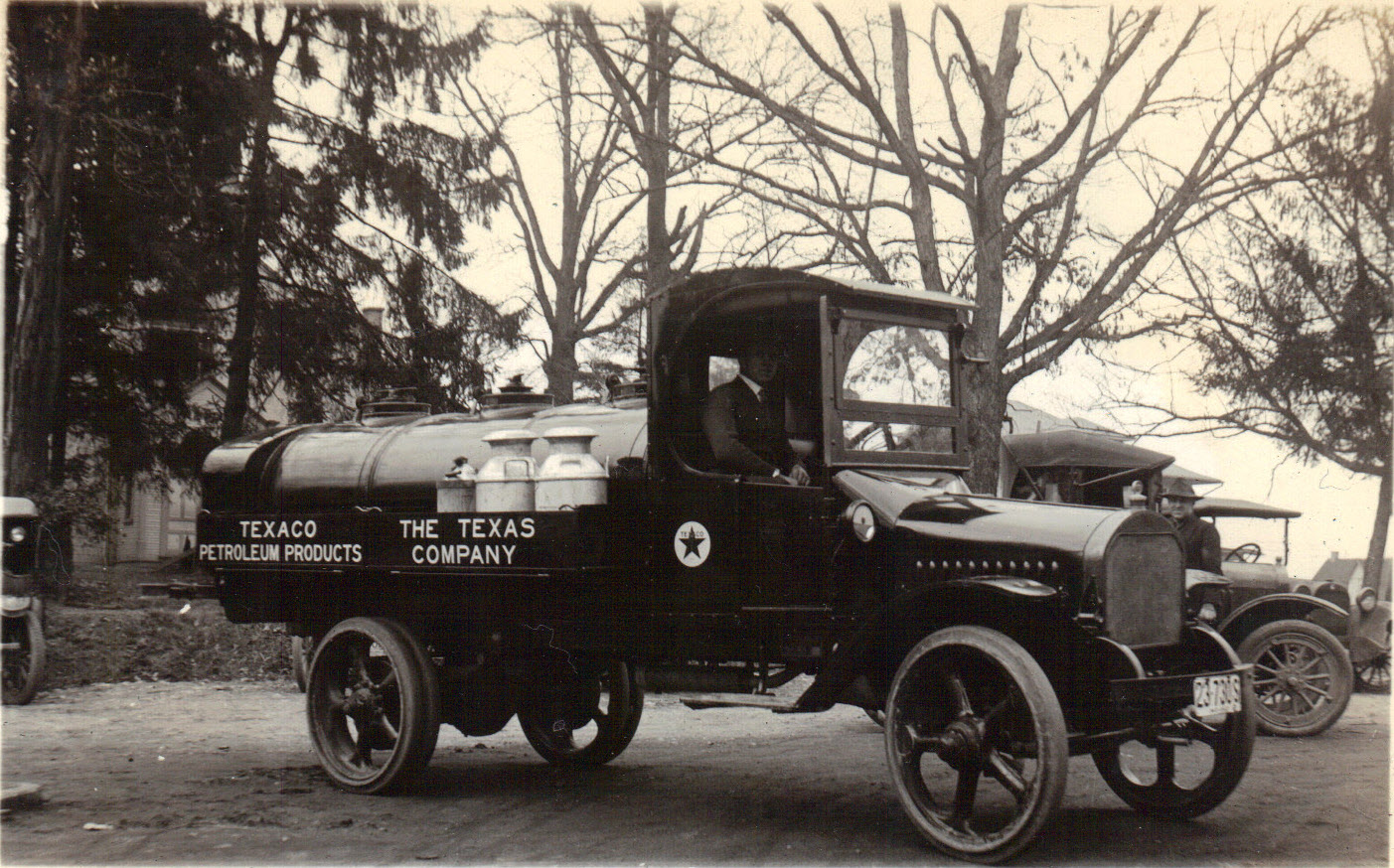
Texaco was founded in Beaumont, Texas as the Texas Fuel Company in 1901. A circa 1917 Texaco Petroleum Truck sits in front of Reed Brothers Dodge after delivering its load of fuel.
This Gasoline Filling Station sign is from the teens and is the same logo seen in the photo above.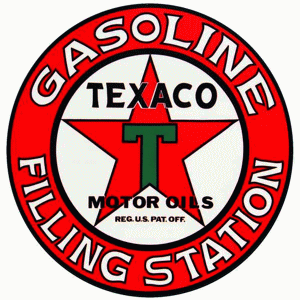
New Milestone: 20K Page Views
 Just a quick post with an offering of thanks to all of you who have read this blog. This evening it hit 20,000 page views, a little over 12 months into its creation.
I’m extremely proud of what this blog has accomplished thus far, and I hope to continue reaching new people as time goes on.
I would also like to take this opportunity to offer a special thank you to Hemmings Daily blogger Daniel Strohl, who posted a link to our Historic Timeline on their own blog which helped boost our page views – Four-Links – NYC cop car show, Reed Brothers Dodge history, coachbuilder Mark Nugent, microcars in the Pacific Northwest written by Daniel Strohl June 22, 2013.
Thank you to everyone who visits us from all around the world…we have so far been visited by folks from all fifty of the United States and 114 different countries world wide.
I’m seriously blown away by the momentum this blog has carried in the way of page views over the past few months. But this blog wouldn’t exist, no matter how great the ideals behind it and no matter how much drive I had to share them, if it weren’t for our readers.

Dodge Brothers Emblem
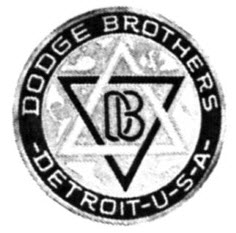
Dodge Brothers logo used from 1914 to 1927
The original Dodge was a circle, with two interlocking triangles forming a six-pointed star in the middle; an interlocked “DB” was at the center of the star, and the words “Dodge Brothers Motor Vehicles” encircled the outside edge. Although the “Brothers” was dropped from the name for trucks in 1929 and cars in 1930, the DB star remained in the cars until the 1939 models were introduced.
What’s the meaning behind the Dodge Brothers emblem?
Unfortunately, John and Horace Dodge died before they publicly told anyone how they arrived at this symbol. If any family members knew the reasons behind this, nothing was ever revealed or discovered. Apparently no one thought to ask them!
Among the possibilities:
1. These are two interlocking Greek letter “deltas” or “D s” for the two Dodge brothers
2. A medieval symbol of mysticism and the joining of mind and body, also possibly the joining of two brothers, who were known to be personally very close, in this business venture.
3. An abstraction of the square and compass of the Freemasons.
4. Nothing more or less than a badge with six pointed star similar to those used for law-enforcement officer’s badges, some outlined with triangles. Sheriff, Marshall, and police badges frequently were and are six pointed stars. The old-west Dodge City badge had six points. Horace Dodge was said to enjoy accompanying local law-enforcement officers on their runs.
5. There are other instances of a company ‘logo” selected for no particular deep meaning other than that it suited the fancy of those who selected it. The Chevrolet “bow-tie” is a classic example, as it was copied from the wall paper of a hotel room.
6. At the time the emblem was selected (most likely 1912-1914) it’s likely that the Dodge brothers were unaware of its use in Judaism. In fact, at this time, that symbol was not used universally in this context.
Rumors that are wrong include:
1. They chose the “Star of David” as a Jewish symbol to anger Henry Ford.
Fact: The brothers were actually friends with Ford at the time the emblem was selected. They were business partners with Ford and even were guests at Edsel Ford’s wedding.
2. They chose the “Star of David” as a Jewish symbol to appease Jewish bankers who financed the business.
Fact: There were no outside investors.
3. The Dodge Brothers were Jewish
Fact: They were not.
Books

Related Resources


Copyright Notice

Reed Brothers Dodge History (1915-2012) by Jeanne Gartner is licensed under a Creative Commons Attribution-NonCommercial 3.0 Unported License.
 Reed Brothers Dodge History 1915 – 2012
Recent Comments