
From Horsepower to Headlines: Reed Brothers’ Early Auto Ads
Advertisements do more than just simply pitch a product, they capture a moment in history. The following early auto ads placed in local newspapers by Rockville Garage/Reed Brothers Dodge do more than mirror the evolution of automotive technology and related advertisement, they present a snapshot of the motoring experience.
Auto ads at the end of the 19th century were similar to the printing technology at that time. Especially at the start of the century, the vintage car prints didn’t have any vehicle image on them and most used black and white paper. But as soon as the 20th century started, vehicles started to appear on the ads with a lot of font style variation. The history of branding begun at the start of the century. However, they used a uniform approach of black and white images, and more focus was on the safety and speed of the car.
The first ever car advertisement in 1898 featured the headline “Dispense With a Horse” and simply sold the benefits of the Winton Motor Carriage. The ad showed that it’s not costly to maintain, its speed is 20 mph, and it had no odor. In the end, the ad compared it with the horse saying that a horse would never be able to do these tasks.
The first ever car advertisement by the Rockville Garage was placed in The Washington Herald less than 20 years later. During the early years, Reed Brothers represented several franchise nameplates along with Dodge, including Oldsmobile, Hudson, and Essex. The Hudson and Oldsmobile were sold at Reed Brothers from roughly 1917 through 1923. Through the years the ads have definitely improved from a timeless, artistic aspect; however the older ads definitely transport you back to a simpler time, both in the car world and in American history.
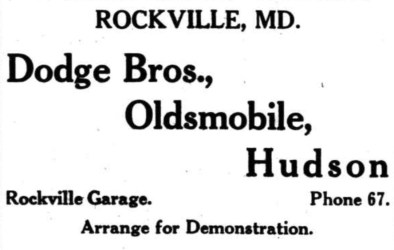
The Washington Herald, Monday, March 5, 1917
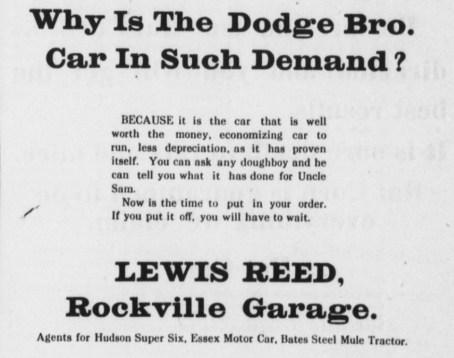
The Montgomery County Sentinel. May 02, 1919
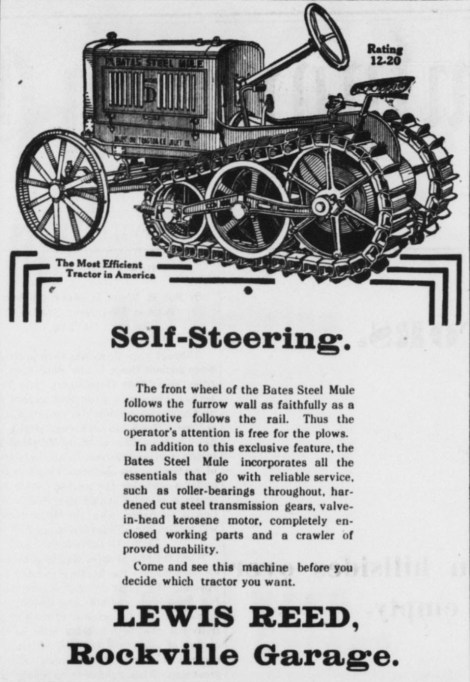
The Montgomery County Sentinel. June 20, 1919
World War I, and the food shortage that came along with it, was a defining moment in history and a direct cause of the rise of the lightweight tractor. — Rick Mannen, editor, Antique Power.
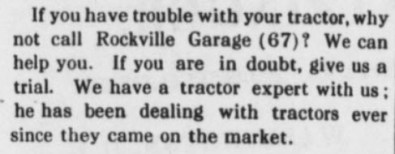
The Montgomery County Sentinel, April 18, 1919
A demonstration of The Bates Steel Mule Tractor will be given on the farm of J.B. Diamond, Jr., near Gaithersburg, on December 3rd and 4th by the Rockville Garage.
Upside Down to Prove Its Strength
We make this test at our store to show the strong, rigid body construction of the Hudson and Essex Coaches. In this position it is supporting a crushing load of 2700 pounds. Come see it. Test the doors and windows, which operate with ease, showing a total absence of body strain.
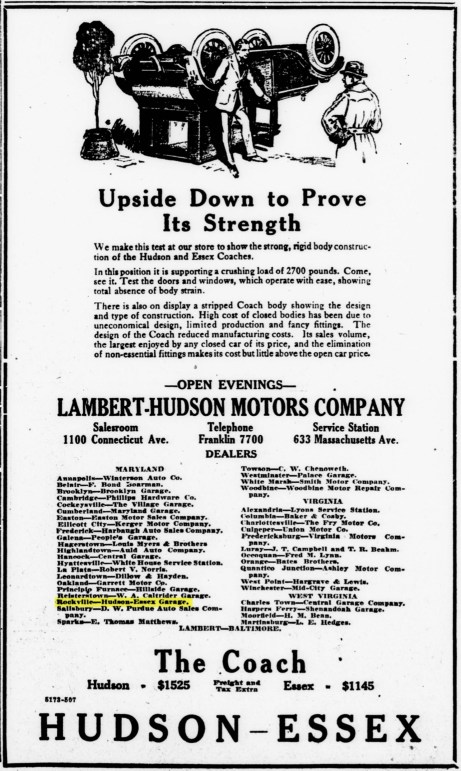
Rockville Garage Hudson-Essex Advertisement: The Evening Star, Washington DC, March 1, 1923
Dependability, The Dependables (1920s-1967)
Capitalizing on their reputation, the Dodge Brothers used their name, “Dodge Brothers” followed by “Reliable, Dependable, Sound” to market their products. Devoted Dodge customers raved about the rugged construction, quality, and power of their vehicles. Buyers consistently commented that this was a car that could be depended upon. In a Dodge marketing stroke of genius, Theodore MacManus coined the word “dependability.” Dodge was using the term in advertising from around 1914, and by the 1930’s, the word was appearing in dictionaries, and soon found its way into common, everyday usage.
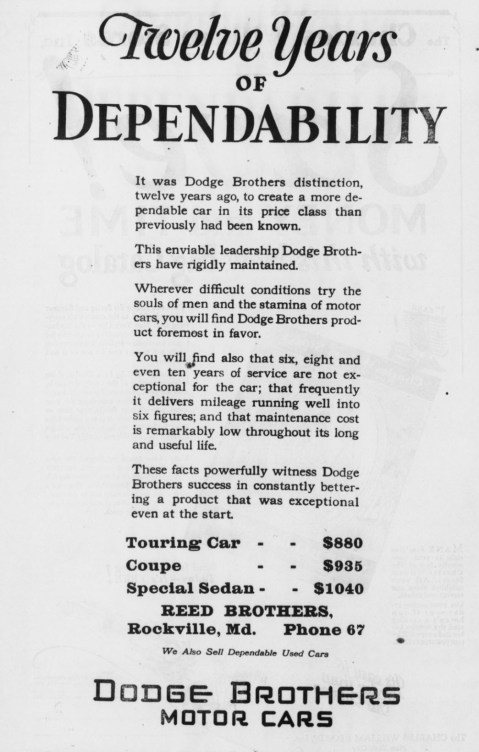
Montgomery County Sentinel. Feb 25, 1927
Dodge “Punishment Pit” – Torture Makes Them SAFER!
Rather than trying to compete with other manufactures with claims of mechanical prowess, Dodge tried a different approach in 1933 with their “Show Down” Plan.
Did you know that Dodge Brothers corporation had a “punishment pit”? This pit was a new type of automobile proving ground that was regarded as the quickest and most satisfactory way of finding out how an automobile can stand up under treatment of the most severely abnormal sort. Before Dodge introduced its latest models, some of the test cars were tortured in the punishment pit for as long as 600 hours.
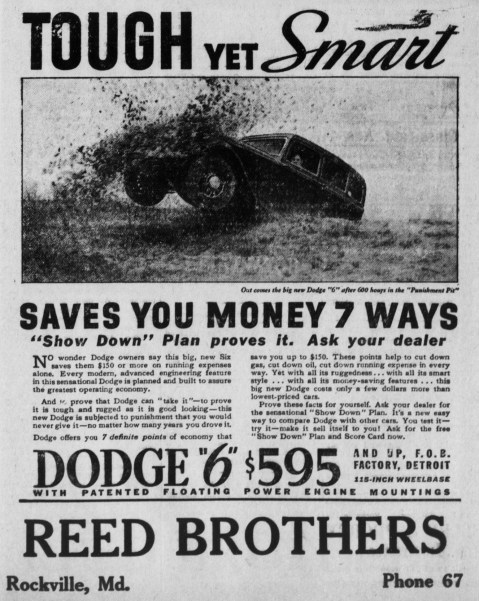
The Montgomery County Sentinel. August 24, 1933
The 1930s seemed to be the last great age of the publicity stunt for automobiles. Radio had already made inroads, and within a decade or two television would become the next great medium to reach the masses, but in the 1930s promoting new cars to a nationwide audience still took some creativity, something that Dodge had plenty of.
The Dodge Boys White Hat Specials (late 1960s)
In the late ’60’s, The Dodge Boys “White Hat Specials” were part of Dodge’s marketing and advertising campaigns. In these ads, the Dodge sales people, “the Dodge Boys,” were referred to as “good guys in white hats” and portrayed as friendly, helpful, and customer-oriented, as well as able to “beat the competition to the draw.”
Here are clips from a two-page ad that Reed Brothers ran in The Gaithersburg Gazette on Thursday, August 26, 1965 to promote their 50th anniversary. The title of the ad reads: “The Dodge Boys and Reed Brothers celebrate a 50 Year Success, 1915 to 1965! If you need a New or Used Car, come in today and cut yourself a “Slice of Savings…”
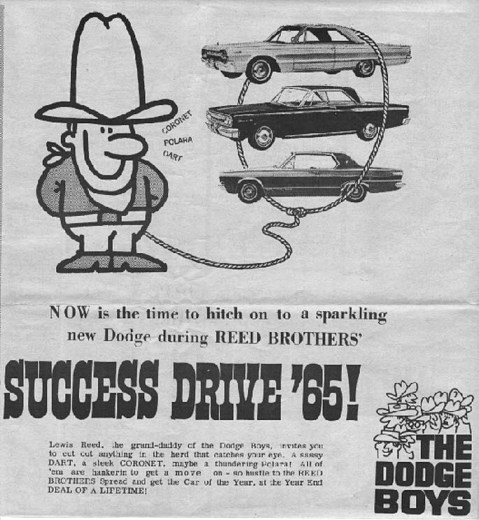
The Gaithersburg Gazette. Thursday, August 26, 1965
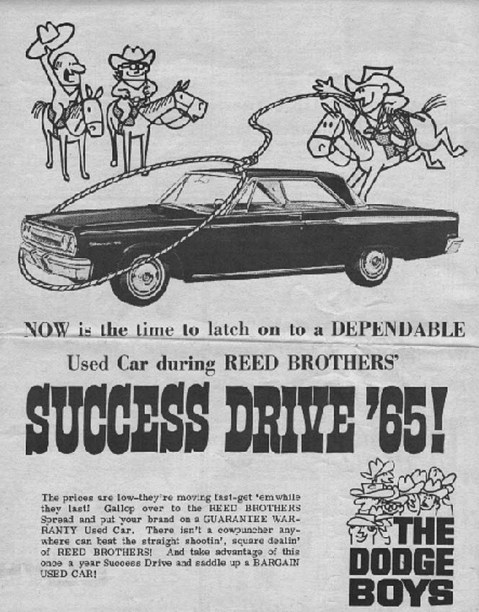
The Gaithersburg Gazette. Thursday, August 26, 1965
May 28, 1928 – Chrysler Buys the Dodge Brothers Company

1928 Chrysler logo
May 28, 1928 marks an important milestone in the history of Chrysler. It was on this day in 1928 that Dodge Brothers, Inc. became a part of Chrysler. It was on this same date that Lewis Reed, founder of Reed Brothers Dodge in Rockville, Maryland also became an original member of the Chrysler family.
During 1920, the Dodge Brothers company lost its founding fathers. John Dodge died in January, and his younger brother Horace succumbed the following December. A New York investment banking firm paid the brothers’ widows, in a single cash payment, $146 million for the Dodge Brothers firm. Within three years, the bankers initiated negotiations, and on May 28, 1928, Walter P. Chrysler purchased Dodge Brothers, Inc. for $170 million, making it, at the time, the largest business transaction in history. When the transaction was complete, the Chrysler Corporation had grown five-fold overnight to become the third of Detroit’s “Big Three” automakers.
The first Plymouth was built in 1928 and Plymouths were sold at Reed Brothers until 1969, when the Plymouth brand was given to the Chrysler dealers.
Happy Birthday to Lewis Reed Founder of Reed Brothers Dodge

This ca. 1965 photo of Lewis Reed was taken in the new car showroom at Reed Brothers Dodge original location at the triangle at Veirs Mill Road and Rockville Pike.
Happy 136th birthday Lewis Reed! The founder of Reed Brothers Dodge was born on this day in 1887 in Darnestown, Maryland. In 1915, he founded what would become the oldest Dodge dealership under the same family ownership in the state of Maryland, and one of the oldest in the entire nation.
Lewis Reed was just 27 years old when he started selling cars built by brothers Horace and John Dodge in Detroit. Few people jumped onto the Dodge Brothers bandwagon earlier than Lewis Reed, and not many have lasted longer. Reed Brothers was franchised as a Dodge dealership and service facility less than one year after the first Dodge automobile rolled off the assembly line. Lewis Reed was the first to sell Dodge cars in Montgomery County, Maryland and his company was the first Gulf gas dealer in the Washington, D.C. area. During the early years, Reed Brothers represented several franchise nameplates along with Dodge, including Oldsmobile, Hudson and Essex. The Hudson and Oldsmobile were sold at Reed Brothers from roughly 1917 through 1923.
Lewis Reed was a member of the Gaithersburg Grace Methodist Church where he served as a member and Chairman of the Board of Stewards, a Lay Leader, and President of the Men’s Bible Class. He was one of nine original incorporators of the Gaithersburg-Washington Grove Volunteer Fire Department when it was created by charter in 1928. He was a Charter Member and Past President of the Gaithersburg-Washington Grove Fire Department and a member of the advisory board of the Rockville Branch of the First National Bank of Maryland. He belonged to the Masonic Lodge of Rockville, the Pentalpha Chapter of the Eastern Star and the Rockville Rotary Club. Before opening his Dodge dealership in 1915, Lewis Reed was one of the earliest and most prolific photographers in Montgomery County. Many of his photographs are now part of Montgomery History’s photo archives. Unsurprisingly, his love of both cars and cameras resulted in his taking numerous pictures of car culture all over the State of Maryland as it developed from infancy to supremacy.
Prior to World War I, Lewis Reed’s love of automobiles led him to becoming a chauffeur. Chauffeurs were not only trained to be proficient with their driving skills, but they also had to keep the luxury automobiles in tip top shape which is where his mechanic training would have come into play. He received his training as an automobile mechanic at the Pierce Arrow factory at Buffalo, New York, the Dodge and Hudson factories at Detroit and the Washington Auto College.
Active in the dealership daily until the day of his death, Lewis Reed passed on January 28, 1967 at the age of 79. Shortly after his death, the Senate of Maryland passed Senate Resolution No. 10, expressing “the deepest regret and sympathy of every member of this body,” describing Reed as “a kindly and loyal person completely devoted to his duties” which he carried out “with fairness and human understanding.” The resolution was sponsored by Senator Thomas M. Anderson, Jr. and Senator Louise Gore.
When you look back and consider what has taken place in the world in the past 100 years or so, you gain a perspective of what Lewis Reed faced. He overcame a lot of obstacles throughout his life. He steered his dealership through World War I, The Great Depression and World War II. When Reed Brothers had no new cars to sell for three and a half years and many dealers went bankrupt, he converted his car showroom into a display room and sold GE Washing Machines, Westinghouse Radios, and other large appliances. Reed Brothers Dodge occupied two locations, the original at the Veirs Mill Road and Rockville Pike intersection and the second at 15955 Frederick Road in front of the Shady Grove Metro.
Lewis Reed set an outstanding example through his success, but more importantly through his sacrifices and commitment to the community he served. Today, Bainbridge Shady Grove Metro Apartments pays tribute to the oldest Dodge dealership in Maryland with commemorative art on the former site of the iconic Reed Brothers dealership.

Bainbridge Shady Grove Metro Apartments now stands on the former site of the Reed Brothers Dodge dealership at 15955 Frederick Road. A sculpture now installed on the property pays tribute to the oldest Dodge dealership in Maryland history. More than 20 feet high, and over 6 feet wide, the public art is inspired by 1939 Dodge headlamps, and the fender of a 1957 Dodge pickup truck.
The First Plymouth Automobile Debuted on This Date 94 Years Ago
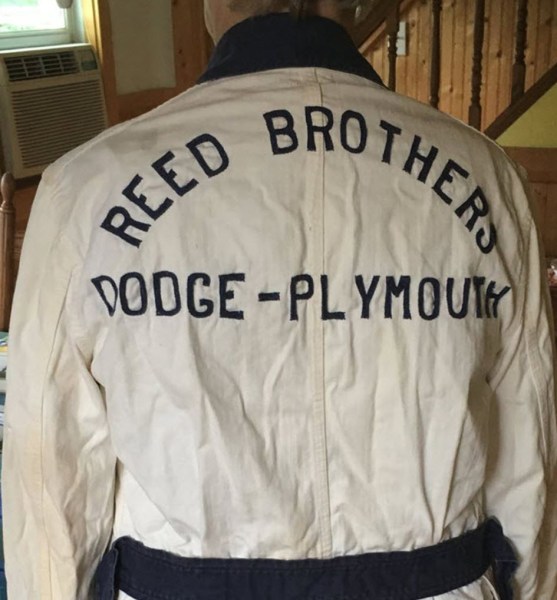
Plymouths were sold at Reed Brothers from 1930-1969. Pictured is an original 1940s Reed Brothers Dodge-Plymouth three-pocket shop coat made by Anderson Bros. of Danville, VA.
The first Plymouth automobile was introduced on July 7, 1928. Plymouth was Chrysler Corporation’s first entry in the low-priced field, which at the time was already dominated by Chevrolet and Ford. Plymouths were actually priced slightly higher than their competition, but offered all standard features such as internal expanding hydraulic brakes that the competition did not provide. While the original purpose of the Plymouth was to serve a lower-end marketing niche, during the Great Depression of the 1930s, the marque helped significantly in ensuring the survival of the Chrysler Corporation in a decade when many other car companies failed. Beginning in 1930, Plymouths were sold by all three Chrysler divisions (Chrysler, DeSoto, and Dodge).
Plymouth sales were a bright spot during this dismal automotive period, and by 1931 Plymouth rose to the number three spot among all cars. Plymouth almost surpassed Ford in 1940 and 1941 as the second most popular make of automobiles in the U.S.
In 1957, Virgil Exner’s new Forward Look design theme, produced cars with much more advanced styling than Chevrolet or Ford. 1957 total production soared to 726,009, about 200,000 more than 1956, and the largest output yet for Plymouth. However, the 1957–1958 Forward Look models suffered from poor materials, spotty build quality and inadequate corrosion protection; they were rust-prone and greatly damaged Chrysler’s reputation.
Most Plymouth models offered from the late 1970s onward, such as the Volaré, Acclaim, Laser, Neon, and Breeze, were badge-engineered versions of Chrysler, Dodge, or Mitsubishi models. By the 1990s, Plymouth had lost much of its identity, as its models continued to overlap in features and prices with Dodges. Plymouth’s product offerings and buyer appeal, and sales continued to fall.
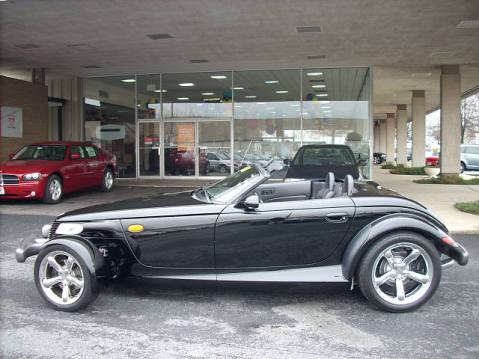
This Limited Edition 1999 Plymouth Prowler convertible was a vehicle from the dealership owners’ private collection. Photo by blog author.
By the late 1990s, only four vehicles were sold under the Plymouth name: the Voyager/Grand Voyager minivans, the Breeze mid-size sedan, the Neon compact car, and the Prowler sports car, which was to be the last model unique to Plymouth. The Prowler came about as part of Chrysler’s efforts (the last as it turned out) to differentiate Plymouth from the rest of its lineup in hopes of keeping the brand alive. It was hoped that it would be received well enough to garner some attention, some of which might spill over into some of their other models.
Plymouth rarely exceeded 200,000 cars per year after 1990. Consequently, DaimlerChrysler decided to drop the make after a limited run of 2001 models. This was announced on November 3, 1999.
Lewis Reed as a Chauffeur-Mechanic
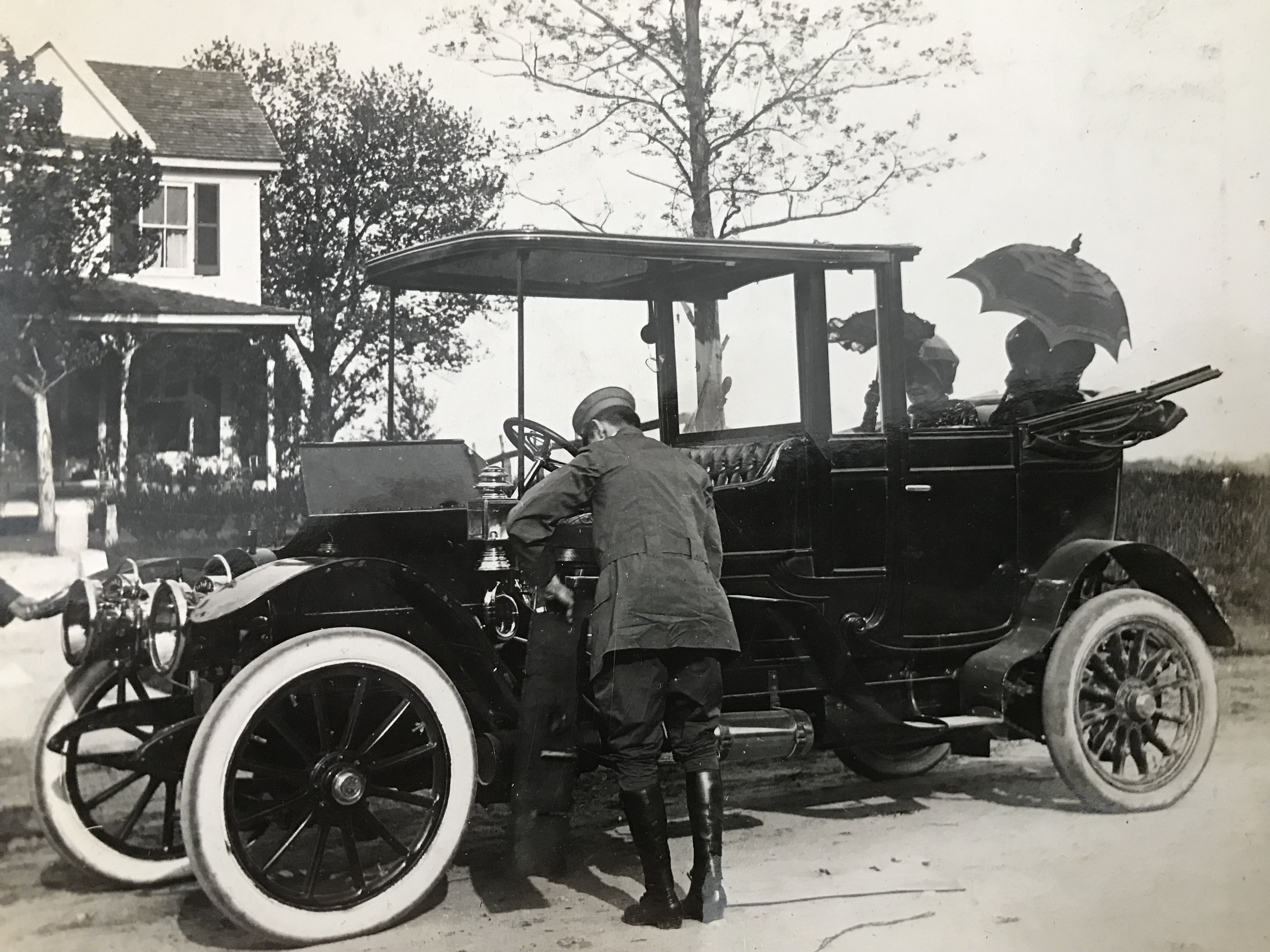
Two ladies with parasols are sitting in the landaulet section of an early Pierce-Arrow limousine, while chauffeur Lewis Reed tends to the motor. The rear portion of the limousine is partitioned from the driver with a glass shield, and covered by a convertible top, which you can see is currently in the lowered position behind the ladies. Photo taken circa 1910.
The year is 1910 and you’ve just purchased a brand new automobile. To show it off for the first time, you’ve hired a knowledgeable chauffeur. You sit on a padded seat while the chauffeur tends to the engine. Though it takes a while to start up, your new ride can reach around 37 mph. The ride is a bumpy one, and you could probably walk faster than the car travels. Ooops! One of the wheels has popped off as you go around a bend. Chauffeurs were not only trained to be proficient with their driving skills, but they also had to keep the luxury automobiles in tip top shape, which is where Lewis Reed’s mechanic training – a vital skill in the early days of motoring – would have come into play.
Lewis Reed understood automobiles. He knew how they worked and how to fix them. He loved cars and anything associated with them. Prior to World War I, Lewis Reed’s love of automobiles led him to becoming a chauffeur. At the dawn of the early 20th century, society was transitioning from horse-drawn carriages to automobiles. Having grown up in a blacksmith family, he was well positioned to move to the new technology. The 1910 census indicates that 23-year-old Lewis Reed was working as a machinist. Lewis worked as a chauffeur from roughly 1910-1914, before he became involved in the business of selling and repairing automobiles.
Chauffeur-mechanics of the early 1900s were the first group to earn a living working on automobiles. Wealthy people employed private chauffeur-mechanics to not only drive, but also maintain and repair their large, expensive automobiles — rather than learn to do it themselves. The vehicles of the time came with mobile toolboxes often resembling a small hardware store tucked away in the trunk. The early 1900s Pierce-Arrow toolkit included extra intake and exhaust valves, not exactly your typical roadside service. During the height of travel season, Spring through Fall, oil changes were required almost weekly. As you can easily surmise, there had to be someone to keep track of all of the maintenance and upkeep of the vehicle as well as the daily driving.
The novelty of the motor car led many manufacturers to create clothes that were specifically marketed for the automobile driver and his or her passengers. Lewis Reed wore a typical chauffeur’s uniform of the time. His motoring outfit was taken from the military uniform, combining a single or double breasted hip length coat and a pair of knicker pants with tall boots and a traditional driver’s cap. Gauntlet gloves were worn while driving and goggles were worn in open air cars. Goggles obviously protected ones’ eyes from flying pebbles and dirt, but heavy-weight boots ensured that the driver could, when necessary, get out to push a stalled car or fix a punctured tire.
Savvy marketers were especially quick to recognize that automobile owners had “more money to spend” than non-car owners. As these marketers gleefully noted, car owners “spend…more freely than non-[car] owners.” Convincing these customers of the need for special clothes was not too difficult. In fact, some car owners spent nearly as much on their motoring clothes as they did on their cars. The ladies in the photograph with parasols could have used them as an attractive way of shielding themselves from the sun’s rays, or to keep the dust from the dirt roads off their faces.
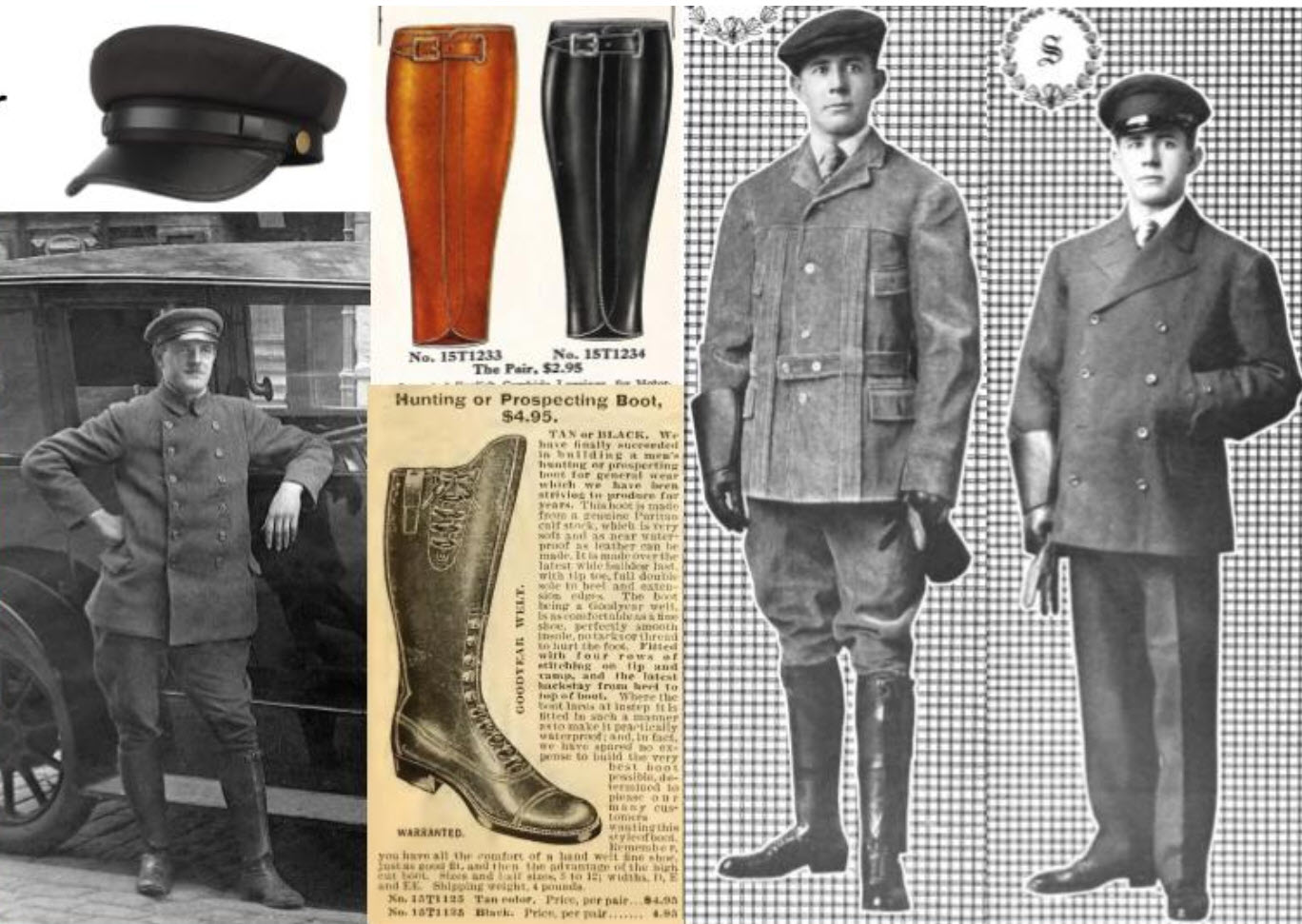
Early 1900s Chauffeur’s uniform
In October of 1915, Lewis Reed opened his Dodge dealership on Rockville Pike, less than one year after the first-ever Dodge automobile rolled off the assembly line. Reed Brothers Dodge provided “wheels” to many families for most of the 20th century during a period when the number of motorcars was rising rapidly throughout Maryland. Few businesses survived the Great Depression and two world wars, but Reed Brothers Dodge eventually emerged from the gauntlet of the 20th century as the oldest Dodge dealership in Maryland history and one of the oldest in the United States.
Books

Related Resources


Copyright Notice

Reed Brothers Dodge History (1915-2012) by Jeanne Gartner is licensed under a Creative Commons Attribution-NonCommercial 3.0 Unported License.
 Reed Brothers Dodge History 1915 – 2012
Recent Comments