
Reed Brothers Car Stories: The 1928 Dodge That Started at $100
Where every car has a story — and every story has a little Reed Brothers history.
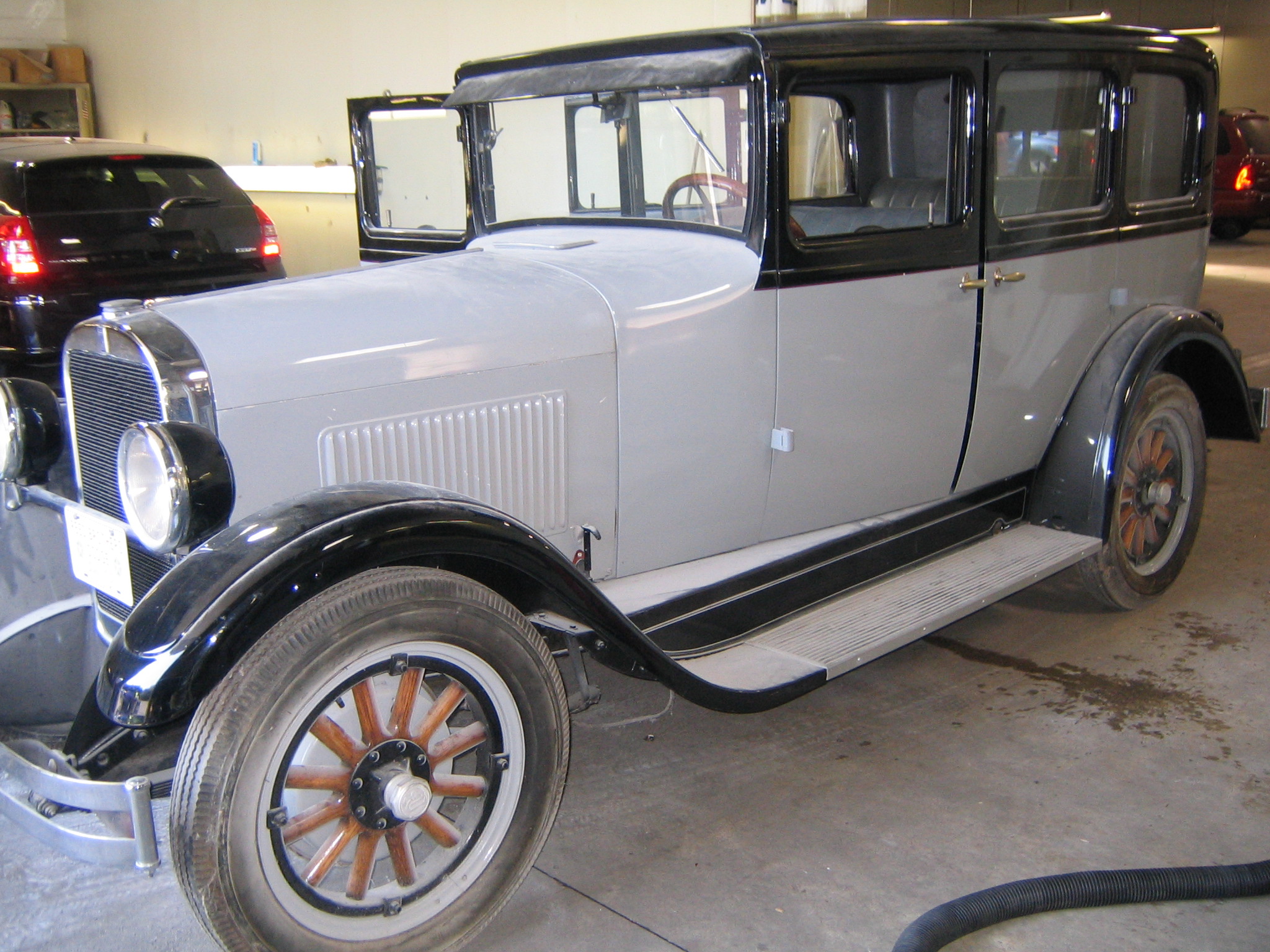
1928 Dodge Brothers Standard Six in the Service Department
Sometimes history rolls into your life when you least expect it. Over a half century ago, a phone call from a Montgomery County used car dealer changed the course of Reed Brothers’ history. The dealer told my dad, “Lee, I have something I want you to see.” What he had was a 1928 Dodge Brothers Standard Six — priced at just $100!
Lee knew the car was in rough shape, but he also knew it was something special. With its vintage charm and connection to Dodge history, the Standard Six was exactly the kind of treasure that belonged with Reed Brothers.
Reed Brothers Restoration: Preserving Automotive History
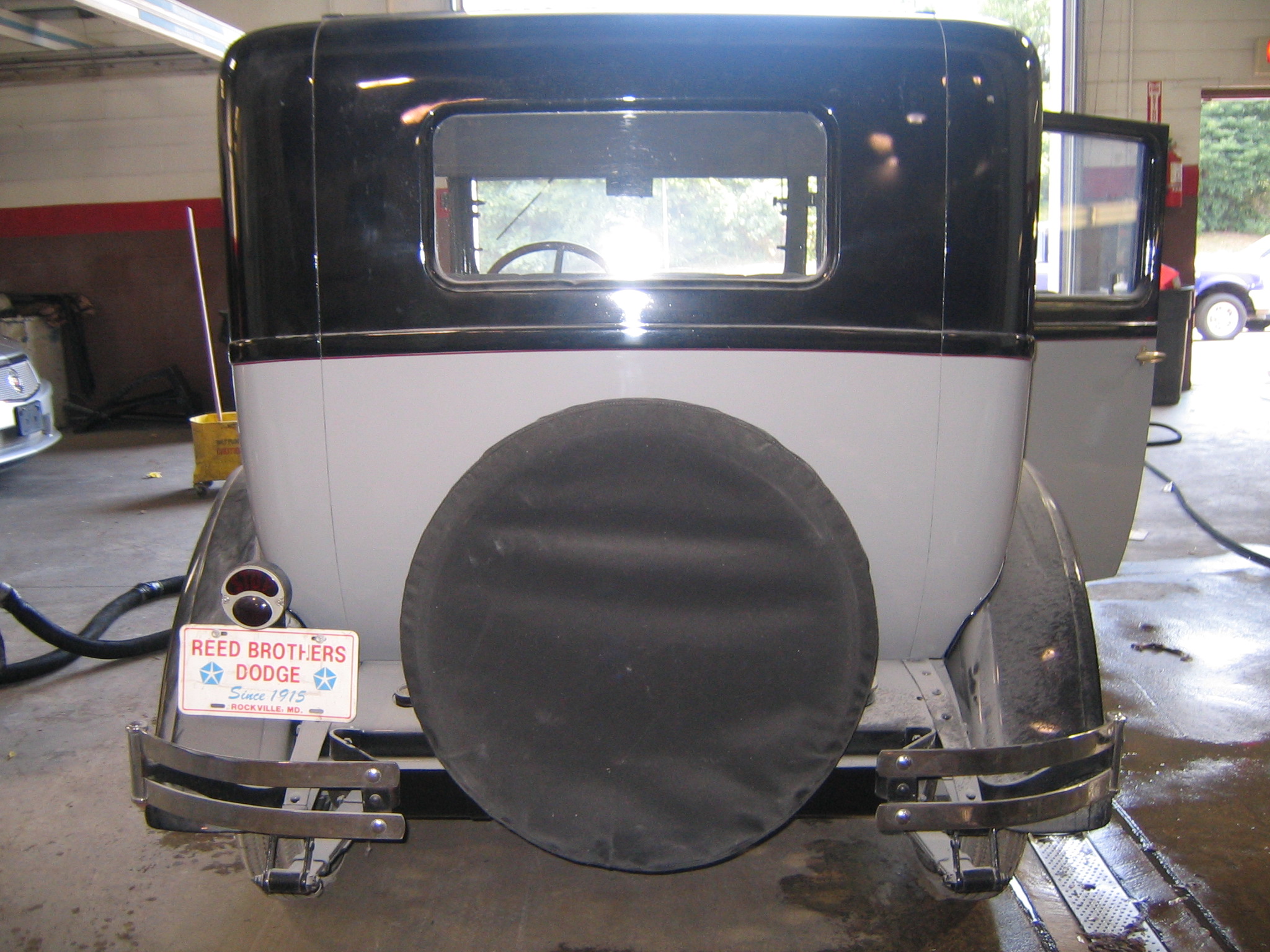
1928 Dodge Brothers Standard Six in the Service Department
In dealer ownership for more than fifty years, the Standard Six became a long-term project and point of pride. Restored and maintained by the Reed Brothers Body Shop and Service Department, the car was not just preserved but celebrated.
Originally selling for $835, the Dodge Brothers Standard Six was powered by a 6-cylinder L-head engine rated at 27.34 hp and had just 46,504 original miles. Over the decades, Reed Brothers’ Body Shop and Service Department meticulously restored and maintained it, giving the vintage Dodge a second life.
A Showroom Conversation Piece
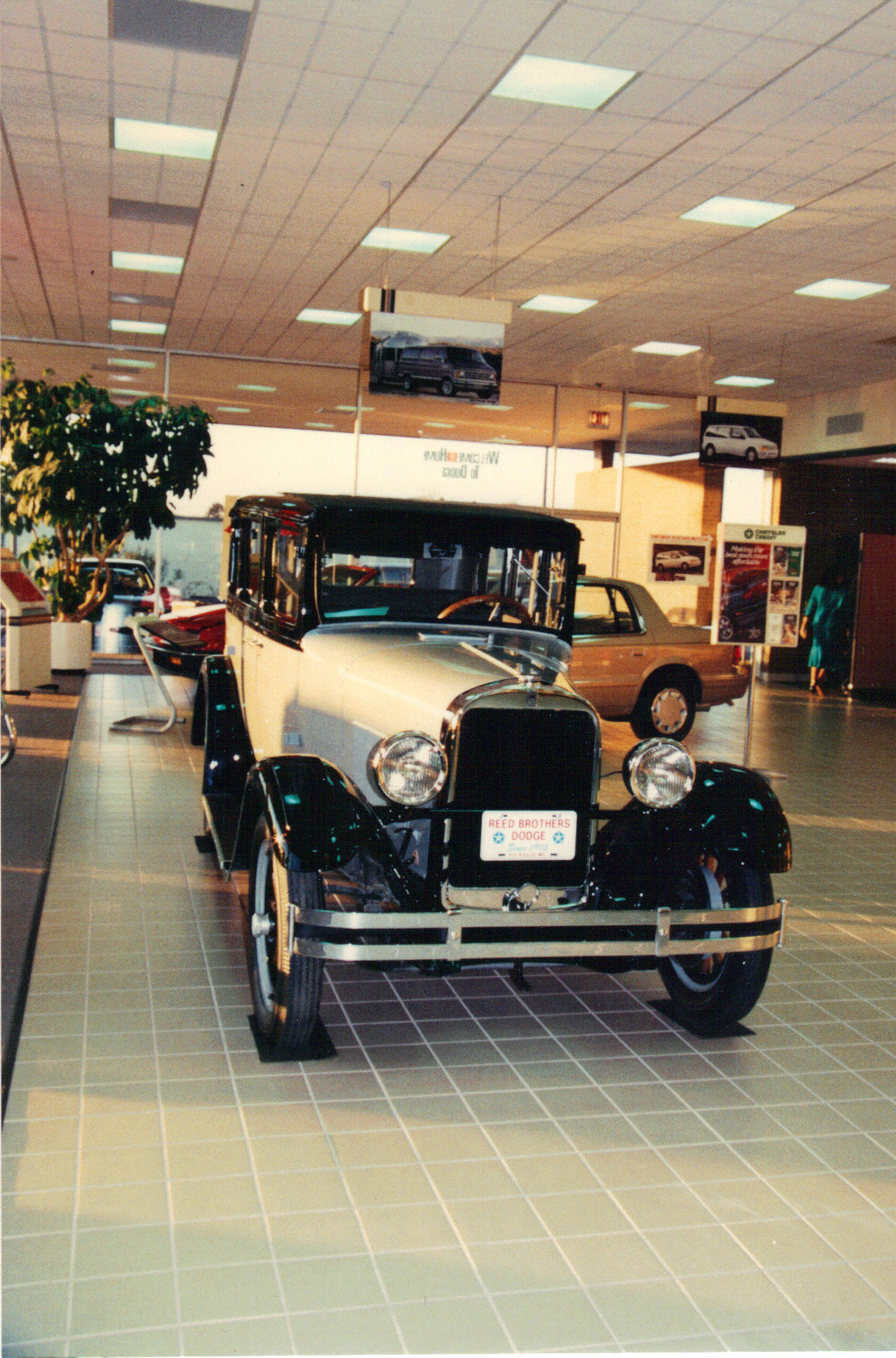
1928 Dodge Brothers Standard Six on the Showroom Floor
Once fully restored, the car was showcased prominently in the showroom, where it became more than just an antique; it was a conversation starter, a link to the past, and a tangible reminder of Dodge heritage. For years, visitors admired it, marveled at its history, and swapped their own car stories in front of it.
In 2012, with the closing of the dealership, the 1928 Dodge Brothers Standard Six ended its decades-long stay with the Reed Brothers family. But the memories of that $100 find, and the dedication it took to bring it back to life, remain an enduring part of Reed Brothers’ story.
How “Suicide Doors” Got Their Name
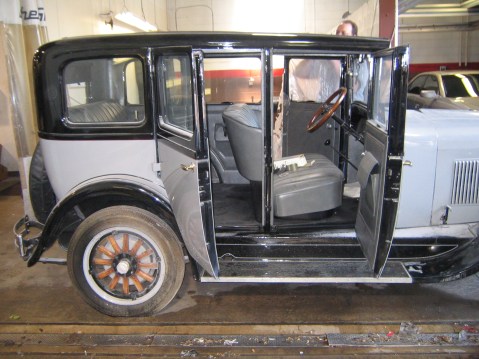
Reed Brothers Dodge owned a 1928 Dodge Brothers Standard Six with rear-hinged “Suicide Doors”.
So why are these doors called suicide doors? Did someone commit suicide with one? What’s suicidal about a door?
The theory is that the forward motion of the car could cause the door to fly open, possibly causing the unlucky person sitting next to the door to be pulled out of the car, or the door itself could be ripped from its hinges. It’s debatable as to whether this was speculation or reality, but cars of this era did not have seat belts, so there was nothing to hold a passenger in the car.
Think about it. Imagine trying to open a conventional front door while you’re driving 70 mph. It’s going to be increasingly difficult because of a simple fact of physics: air pressure. The farther you open the door as you’re sailing down the highway, the more air is going to hit the door, forcing it back. Hopefully, the end result is that it never opens far enough for you to fall out.
Now, imagine accidentally unlatching a door that opens the other way. Instead of working to keep the door shut, the road wind serves as an accelerator, helping to fling the door open and maybe you with it as you grab for the handle in a panic to close it. To add insult to injury, you’ll likely be whopped by the door as you fall out. The term “suicide doors” was therefore placed on vehicles with the rear-hinged door configuration, the theory being that anyone inside was on a suicide mission because of the design.
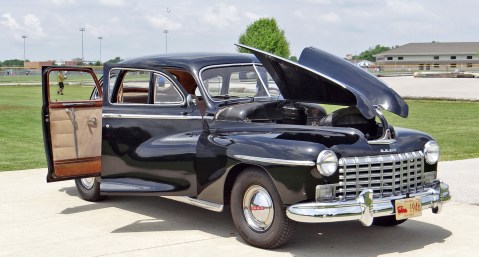
Stock image of a 1946 Dodge Deluxe 4-Door Sedan Fluid Drive with “Suicide Doors”.
Another urban legend about the origins of the suicide doors maintains that 1930s gangsters liked the door design because it made pushing someone out of a moving car easier. If that were true, though, wouldn’t the correct term be “homicide doors”?
Suicide doors were favored in pre-war automobiles throughout the the 1930s. They were fairly common on many domestic and imported car makes in the 1930s. A forward-opening door — either in front or back — permitted easier access and egress — especially for women in long skirts or dresses. Hinging the front door at the rear also facilitated a more slanted windshield.
As a result, manufacturers understandably have tried hard to bury the old “suicide doors” reference. Today, you’ll find such killer names as “RAD” or “rear-access door” (Saturn), “freestyle doors” (Mazda RX-8), “coach doors” (Rolls Royce), “FlexDoors” (Opel), “scissor doors” (Lambo), “clamshell” (Toyota), and “rear-hinged doors” (preferred technical term).
Now, About That Name…
So where did the name “suicide doors” come from, then? You’ll find multiple explanations, none definitive. The fact that no historian can verify the origins of this bit of slang only adds to the mystique.
Source: Wikipedia
Early Car Starters: How Did Old Cars Start?

Lewis Reed hand cranking an old car. The hammer in Lewis Reed’s right hand is for straightening the hand crank. Apparently they can bend when starting big engines. The license plate is MD 10307 dated 1913.
Today, we take the starting of automobiles for granted. Simply place the key in the ignition, turn, and VROOM, the engine starts. Vintage cars from from the 1900s and 1910s were comparatively archaic and limited in their mechanical features. Even starting these old relics was difficult because the process involved a number of complicated steps that the driver had to perform in the correct order.
However, this was not always the case. Hand cranks were the most common type of engine starters in the early days of the automobile. Cars in the early parts of the century had to be started by hand. This was accomplished by turning a crank, usually located in the front of the automobile. The driver would literally “crank the engine” by turning the handle, which would allow the process of internal combustion to begin. After a given number of cranks, the engine would begin to run on its own, and the crank could be removed.
Although hand crank starters were simple and reliable, they suffered from a handful of drawbacks. The main issue with this method of starting an engine is that it is inherently dangerous to the operator. For instance, if an engine kicks back during the cranking process, the operator could get TKO’d by the hand crank. Although many of these cranks used overrun mechanism, there was also a potential for injury if the handle continued to turn after the engine started running.
The other main issue with hand crank starters is that it took a certain degree of physical effort to turn them. That meant anyone who lacked the necessary physical strength or dexterity was incapable of starting a vehicle equipped with this type of starter.
By 1920, nearly all manufacturers were producing cars equipped with starters making it easy for anyone, regardless of physical abilities, to start a car by pressing a button mounted on the dash or floor. An ignition on and starter engage switch operated by a key was introduced by Chrysler in 1949.
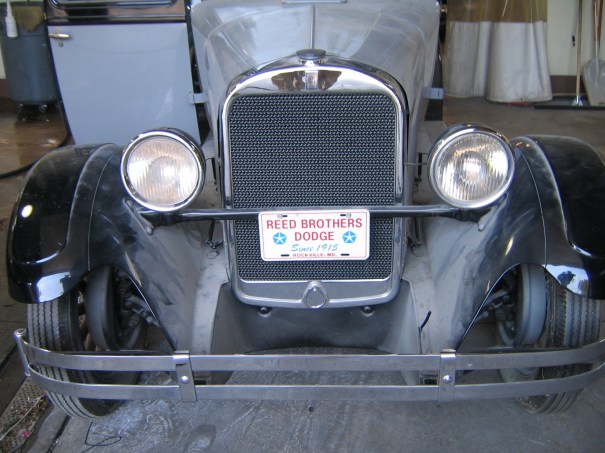
1928 Dodge Brothers Standard Six had both hand crank and starter. I’m assuming the crank was a backup in case the starter failed. The crank hole cover can be seen just below the front grill. Photo by Reed Brothers Dodge
Several new mechanical innovations were included in the 1946 Dodge Deluxe models. Among them were the introduction of the famous Fluid-Drive, a push-button starter system. The dash-mounted button on the 1946 Dodge Deluxe pictured below activated a solenoid, which in turn engaged the starter. For the first time since 1928 there was no provision made to manually hand crank the engine.

The push button starter on this 1946 Dodge Deluxe Fluid Drive was located on the far left, below the instrument gauges. Photo by Reed Brothers Dodge.
Suicide Doors
Reed Brothers Dodge owned a 1928 Dodge Brothers Standard Six with rear-hinged suicide doors.

1928 Dodge Brothers Standard Six
So why are these doors called suicide doors? Did someone commit suicide with one? What’s suicidal about a door?
The theory is that the forward motion of the car could cause the door to fly open, possibly causing the unlucky person sitting next to the door to be pulled out of the car, or the door itself could be ripped from its hinges. It’s debatable as to whether this was speculation or reality, but cars of this era did not have seat belts, so there was nothing to hold a passenger in the car.
The term “suicide doors” was therefore placed on vehicles with the rear-hinged door configuration, the theory being that anyone inside was on a suicide mission because of the design.
Books

Related Resources


Copyright Notice

Reed Brothers Dodge History (1915-2012) by Jeanne Gartner is licensed under a Creative Commons Attribution-NonCommercial 3.0 Unported License.
 Reed Brothers Dodge History 1915 – 2012
Recent Comments