
From Horsepower to Headlines: Reed Brothers’ Early Auto Ads
Advertisements do more than just simply pitch a product, they capture a moment in history. The following early auto ads placed in local newspapers by Rockville Garage/Reed Brothers Dodge do more than mirror the evolution of automotive technology and related advertisement, they present a snapshot of the motoring experience.
Auto ads at the end of the 19th century were similar to the printing technology at that time. Especially at the start of the century, the vintage car prints didn’t have any vehicle image on them and most used black and white paper. But as soon as the 20th century started, vehicles started to appear on the ads with a lot of font style variation. The history of branding begun at the start of the century. However, they used a uniform approach of black and white images, and more focus was on the safety and speed of the car.
The first ever car advertisement in 1898 featured the headline “Dispense With a Horse” and simply sold the benefits of the Winton Motor Carriage. The ad showed that it’s not costly to maintain, its speed is 20 mph, and it had no odor. In the end, the ad compared it with the horse saying that a horse would never be able to do these tasks.
The first ever car advertisement by the Rockville Garage was placed in The Washington Herald less than 20 years later. During the early years, Reed Brothers represented several franchise nameplates along with Dodge, including Oldsmobile, Hudson, and Essex. The Hudson and Oldsmobile were sold at Reed Brothers from roughly 1917 through 1923. Through the years the ads have definitely improved from a timeless, artistic aspect; however the older ads definitely transport you back to a simpler time, both in the car world and in American history.
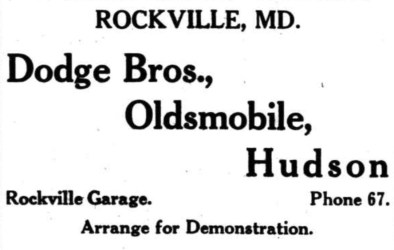
The Washington Herald, Monday, March 5, 1917
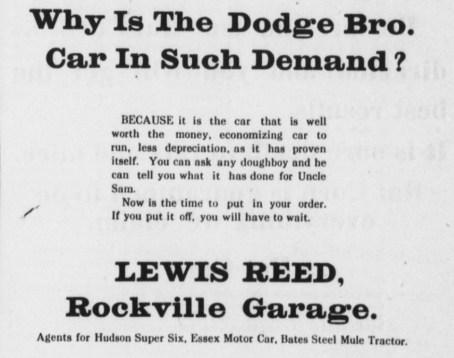
The Montgomery County Sentinel. May 02, 1919
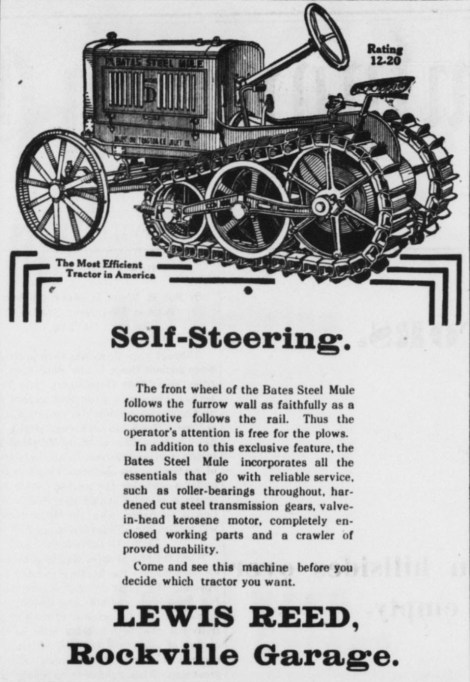
The Montgomery County Sentinel. June 20, 1919
World War I, and the food shortage that came along with it, was a defining moment in history and a direct cause of the rise of the lightweight tractor. — Rick Mannen, editor, Antique Power.
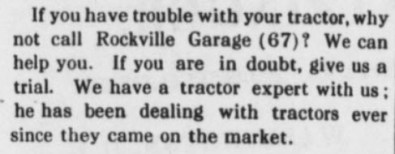
The Montgomery County Sentinel, April 18, 1919
A demonstration of The Bates Steel Mule Tractor will be given on the farm of J.B. Diamond, Jr., near Gaithersburg, on December 3rd and 4th by the Rockville Garage.
Upside Down to Prove Its Strength
We make this test at our store to show the strong, rigid body construction of the Hudson and Essex Coaches. In this position it is supporting a crushing load of 2700 pounds. Come see it. Test the doors and windows, which operate with ease, showing a total absence of body strain.
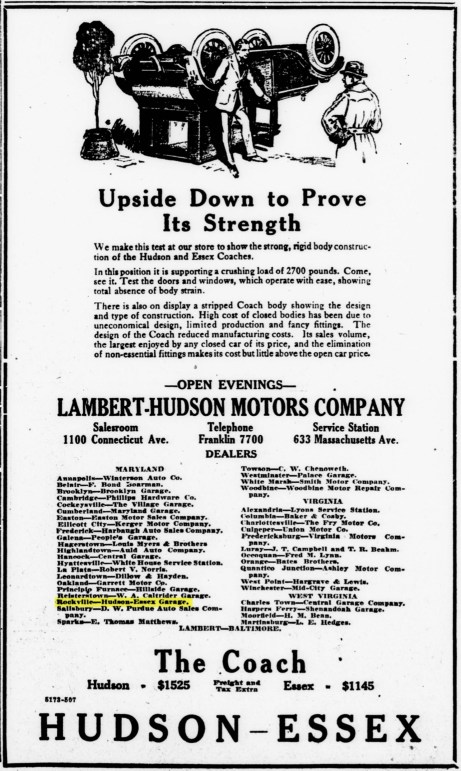
Rockville Garage Hudson-Essex Advertisement: The Evening Star, Washington DC, March 1, 1923
Dependability, The Dependables (1920s-1967)
Capitalizing on their reputation, the Dodge Brothers used their name, “Dodge Brothers” followed by “Reliable, Dependable, Sound” to market their products. Devoted Dodge customers raved about the rugged construction, quality, and power of their vehicles. Buyers consistently commented that this was a car that could be depended upon. In a Dodge marketing stroke of genius, Theodore MacManus coined the word “dependability.” Dodge was using the term in advertising from around 1914, and by the 1930’s, the word was appearing in dictionaries, and soon found its way into common, everyday usage.
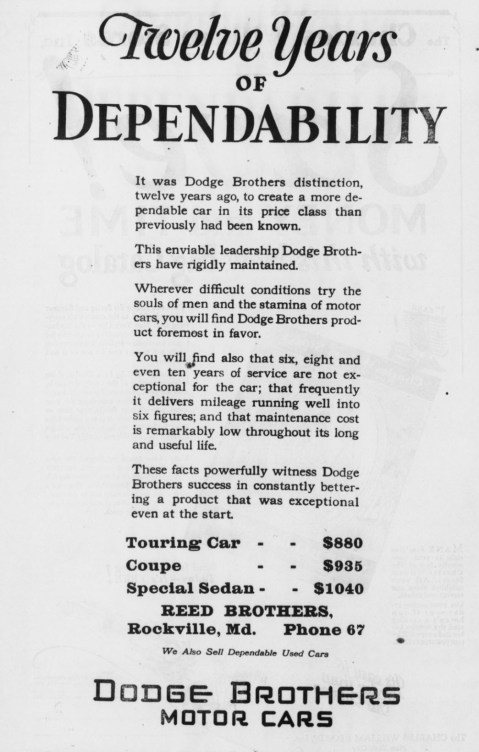
Montgomery County Sentinel. Feb 25, 1927
Dodge “Punishment Pit” – Torture Makes Them SAFER!
Rather than trying to compete with other manufactures with claims of mechanical prowess, Dodge tried a different approach in 1933 with their “Show Down” Plan.
Did you know that Dodge Brothers corporation had a “punishment pit”? This pit was a new type of automobile proving ground that was regarded as the quickest and most satisfactory way of finding out how an automobile can stand up under treatment of the most severely abnormal sort. Before Dodge introduced its latest models, some of the test cars were tortured in the punishment pit for as long as 600 hours.
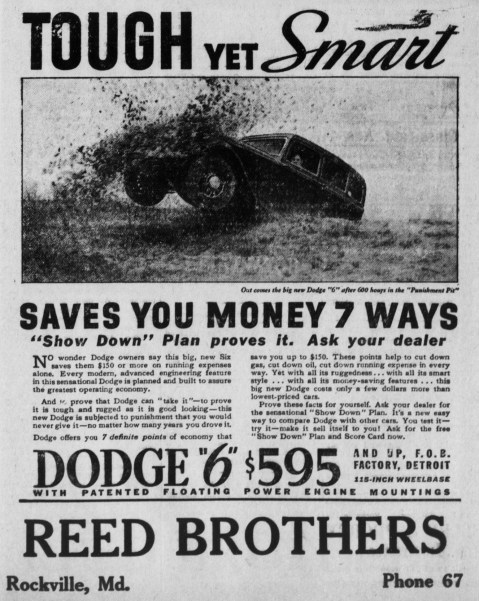
The Montgomery County Sentinel. August 24, 1933
The 1930s seemed to be the last great age of the publicity stunt for automobiles. Radio had already made inroads, and within a decade or two television would become the next great medium to reach the masses, but in the 1930s promoting new cars to a nationwide audience still took some creativity, something that Dodge had plenty of.
The Dodge Boys White Hat Specials (late 1960s)
In the late ’60’s, The Dodge Boys “White Hat Specials” were part of Dodge’s marketing and advertising campaigns. In these ads, the Dodge sales people, “the Dodge Boys,” were referred to as “good guys in white hats” and portrayed as friendly, helpful, and customer-oriented, as well as able to “beat the competition to the draw.”
Here are clips from a two-page ad that Reed Brothers ran in The Gaithersburg Gazette on Thursday, August 26, 1965 to promote their 50th anniversary. The title of the ad reads: “The Dodge Boys and Reed Brothers celebrate a 50 Year Success, 1915 to 1965! If you need a New or Used Car, come in today and cut yourself a “Slice of Savings…”
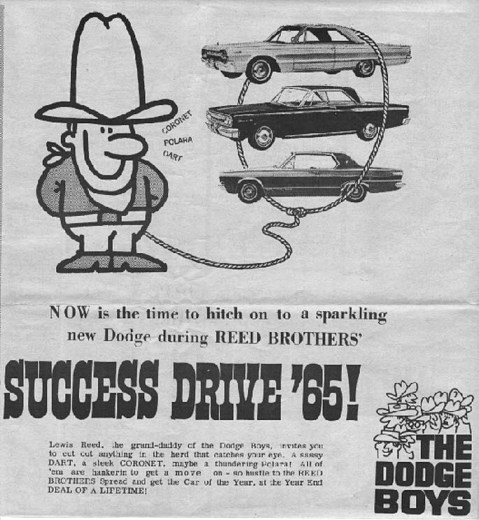
The Gaithersburg Gazette. Thursday, August 26, 1965
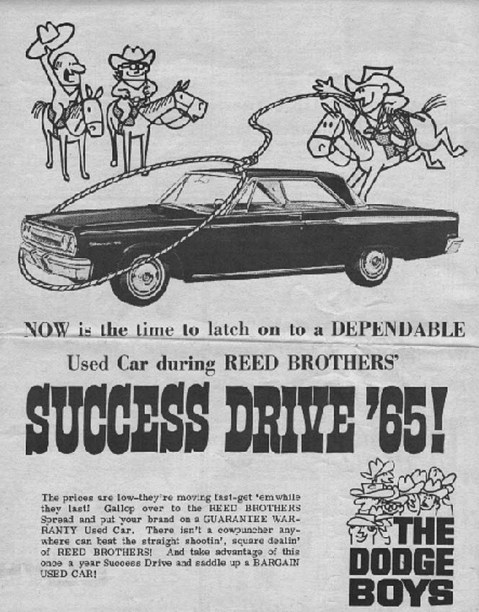
The Gaithersburg Gazette. Thursday, August 26, 1965
New Year Greetings from Lewis and Edgar Reed, 1950
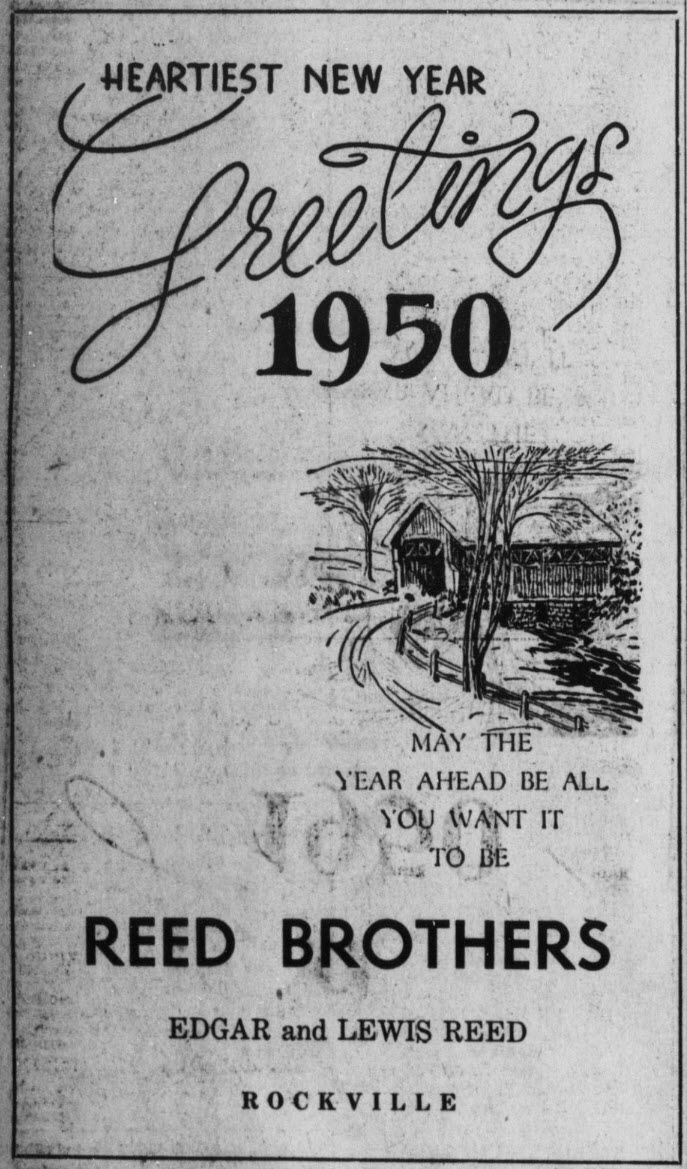
As another year begins, it feels fitting to look back at a New Year greeting shared more than seven decades ago. In the December 29, 1949 edition of the Montgomery County Sentinel, Edgar and Lewis Reed offered a warm message to the community:
“May the year ahead be all you want it to be.”
Simple and sincere, those words still resonate today. They reflect not only the spirit of the season, but also the long-standing connection the Reed family had with Montgomery County and the people they served. In that same spirit, I would like to extend my heartfelt thanks to all the visitors and followers of this blog. Your interest, comments, and support help keep this local history alive and meaningful.
Wishing you all a very Happy New Year, and every good wish for a safe, healthy, and prosperous 2026.

Dodge “Punishment Pit” – Torture Makes Them SAFER!
Did you know that Dodge Brothers corporation had a “punishment pit”? This pit was a new type of automobile proving ground that was regarded as the quickest and most satisfactory way of finding out how an automobile can stand up under treatment of the most severely abnormal sort. Before Dodge introduced its latest models, some of the test cars were tortured in the punishment pit for as long as 600 hours.

Montgomery County Sentinel. August 24, 1933
In these trials, every stunt resulting in mechanical agony to all parts was employed to furnish the engineers and builders with proof of the car’s sturdiness and safety, with its ability to “take it.” Where the owner-driver would steer around chuck holes, dams and other obstacles, the punishment pit driver hunts the obstacles, steps on the throttle and tears right into them. He is exceedingly nimble-footed and can let the car turn over without being injured himself.
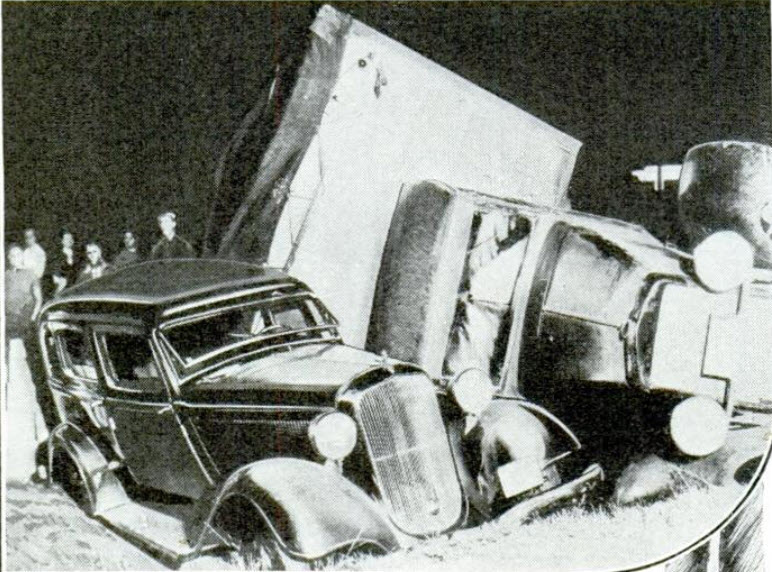
Photo of Plymouth against which a truck overturned; note how steel body resisted impact
Not only in the pit is torture applied to the new models. An ingenious device called the “Belgium roll” is almost as cruel to an automobile as the punishment pit. This machine shakes, rattles and vibrates a car placed upon it in such a vigorous manner that many hidden defects are revealed speedily. A few hours of the Belgium roll subject an automobile to more punishment than months of driving over the roughest roads. The effects of vibration on every part are studied closely by the engineer, changes made here and there, and to the public goes the result of torture —
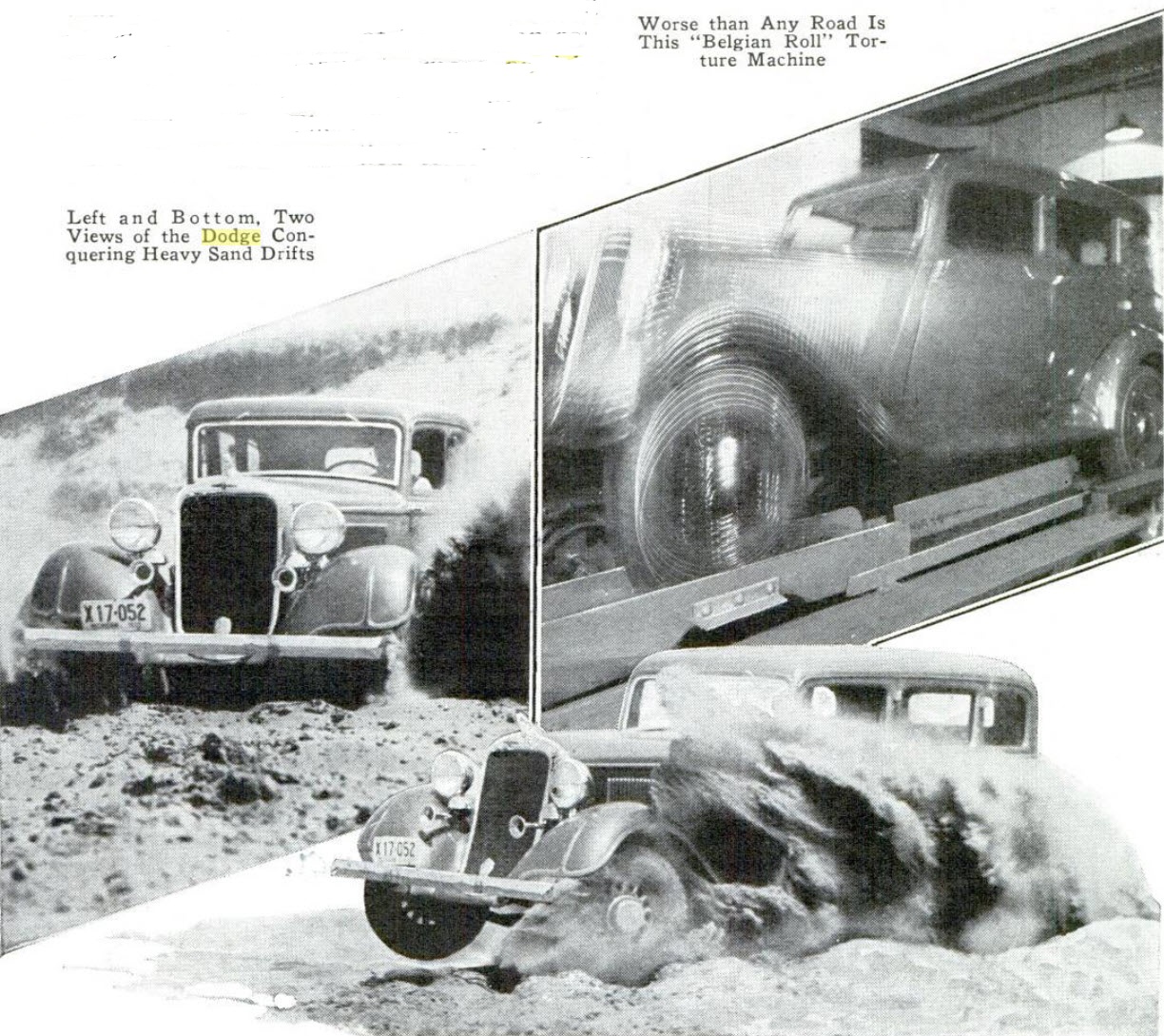 A quiet, safe, smoothly riding automobile that will give years of service.

Big Dodge Six in the torture pit
One unusual test of motor quietness was conducted by Dodge engineers under military supervision. While the engine was running, an expert rifleman sitting in the front seat fired ten shots with a United States army rifle at a regulation target 100 yards away. During aiming and firing, the rifle rested on the windshield. The result was a 100×100 target score.
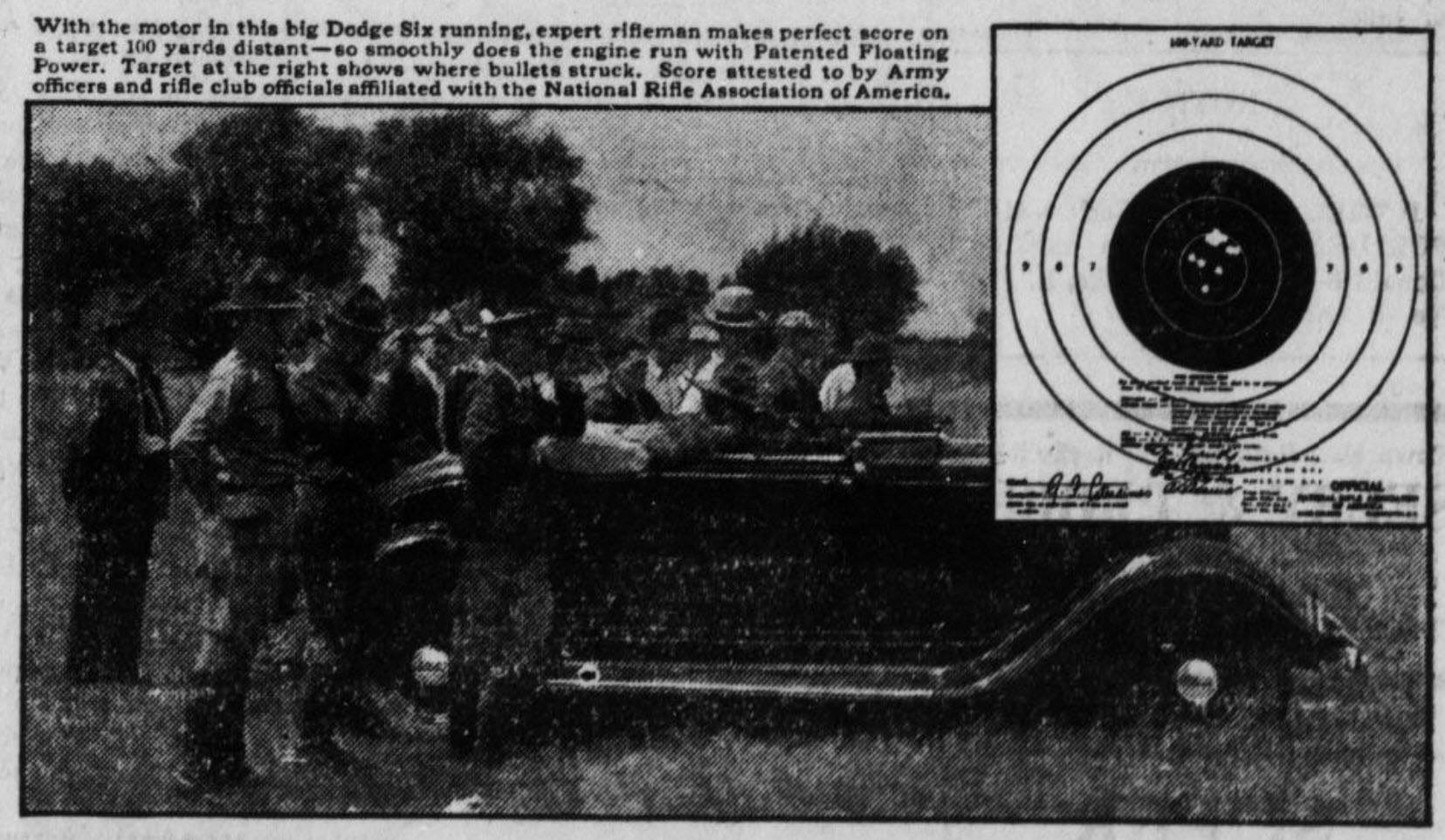
Target shows where bullets struck
Unusual as these tests may appear, they are the means to a common end, that of producing faster, safer and more comfortable automobiles.
Source: Popular Mechanics · Vol. 60, No. 6 · Dec 1933
Introduction of School Buses in Montgomery County
Your parents and grandparents have probably told you stories of walking miles to get to school – uphill both ways of course. Today, most kids take the school bus. In fact, if you were a grade school student the late 1950’s, a Dodge school bus might have been your ride. The first school buses used around Rockville (and in Montgomery County) were furnished by Reed Brothers Dodge.
From The Montgomery County Sentinel, May 21, 1959:
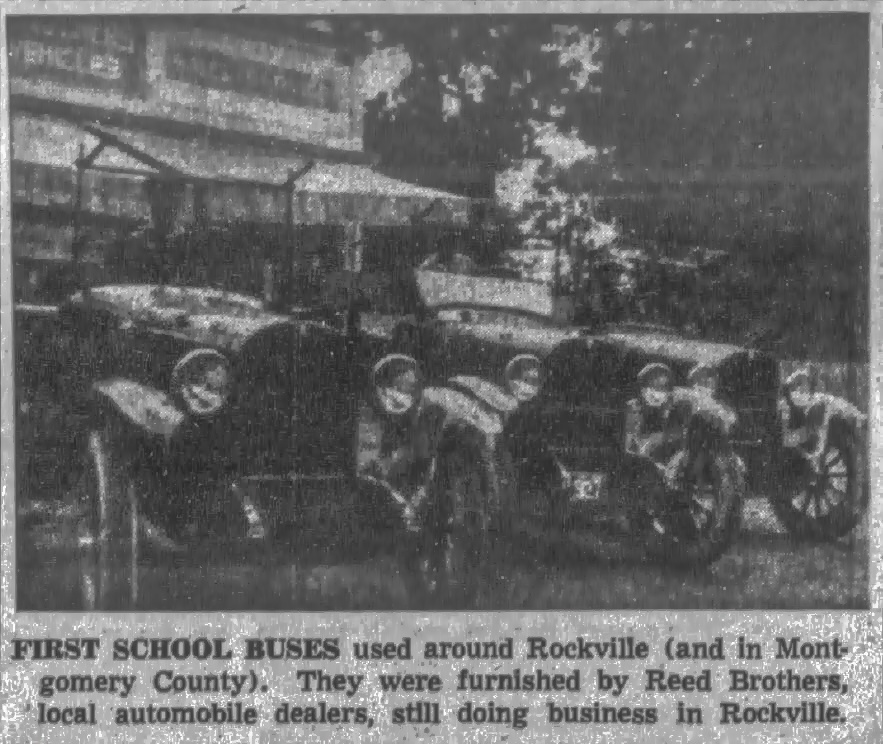
In the 1940s, the school bus started to become a profitable trend, so other companies began to jump on the bandwagon to create their own versions. Fifty years prior, Wayne Works and Blue Bird were the main producers, but around this time mainstream companies like Ford and Dodge used their vast resources to further innovation.

Following the end of WWII, the number of children exploded in America, and that necessitated another redesign for buses. This time they didn’t get wider or safer; this time they got a lot longer. Adding all that length increased overall capacity to around 100 students. It was around this time that the infamous yellow paint job became a national standard as well, so this is the beginning of the school buses we know today.
Upside Down to Prove Its Strength
The advertisement in this post does more than just simply pitch a product, it captures a moment in history. A moment in history when Lewis Reed’s Rockville Garage represented several franchise nameplates along with Dodge, including Hudson and Essex. The Hudson and Essex were sold at Reed Brothers from roughly 1917-1923. Rockville–Hudson-Essex–Garage, is highlighted in yellow in the ad below. In addition to franchise car dealers, there were also factory stores. In the early days, the factory stores did the national advertising. A factory store, also known as a branch store or branch dealer, was a dealership owned and run by the manufacturer. A list of area Dealers was placed in fine print at the bottom of the ads.
The upside down coach on the dealers sales floors to demonstrate strength and sturdiness of construction is what proved effective in selling the Hudson and Essex.
We make this test at our store to show the strong, rigid body construction of the Hudson and Essex Coaches. In this position it is supporting a crushing load of 2700 pounds. Come see it. Test the doors and windows, which operate with ease, showing a total absence of body strain.
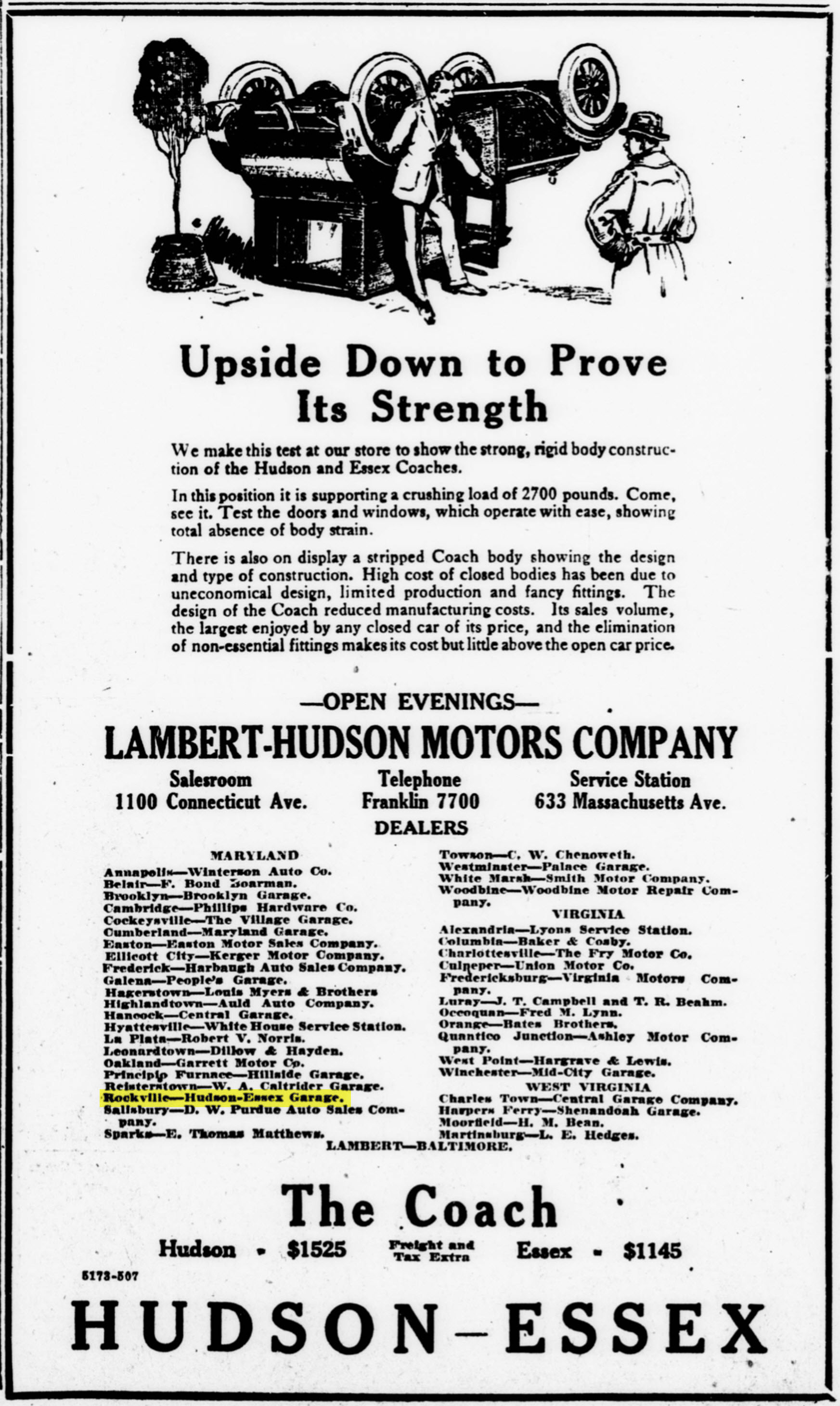
Rockville Garage Hudson-Essex Advertisement: The Evening Star, Washington DC Thursday, March 1, 1923
Hudson introduced the Essex brand in 1919. The Essex was intended to compete with Ford and Chevrolet for budget-minded buyers. The Essex offered one of the first affordable sedans and by 1925 the combined Hudson and Essex sales made Hudson the third largest automobile manufacturer in the United States.
The Hudson Motor Company, assisted by advertising a stripped Coach body and a chassis, and by a display of the individual parts that go into the Hudson and Essex cars, resulted in the sale of 75 Hudson and Essex cars the first 10 days. During its production run, the Essex was considered a small car and was affordably priced. The Essex is generally credited with starting a trend away from open touring cars design toward enclosed passenger compartments. By 1922 the Essex Motor Company was dissolved and the Essex officially became a product of Hudson.
In 1923, the big news was the demonstration the values the Hudson and Essex purchasers received. The advertisement below demonstrates the strength of the rigid body construction of the Essex Coach.
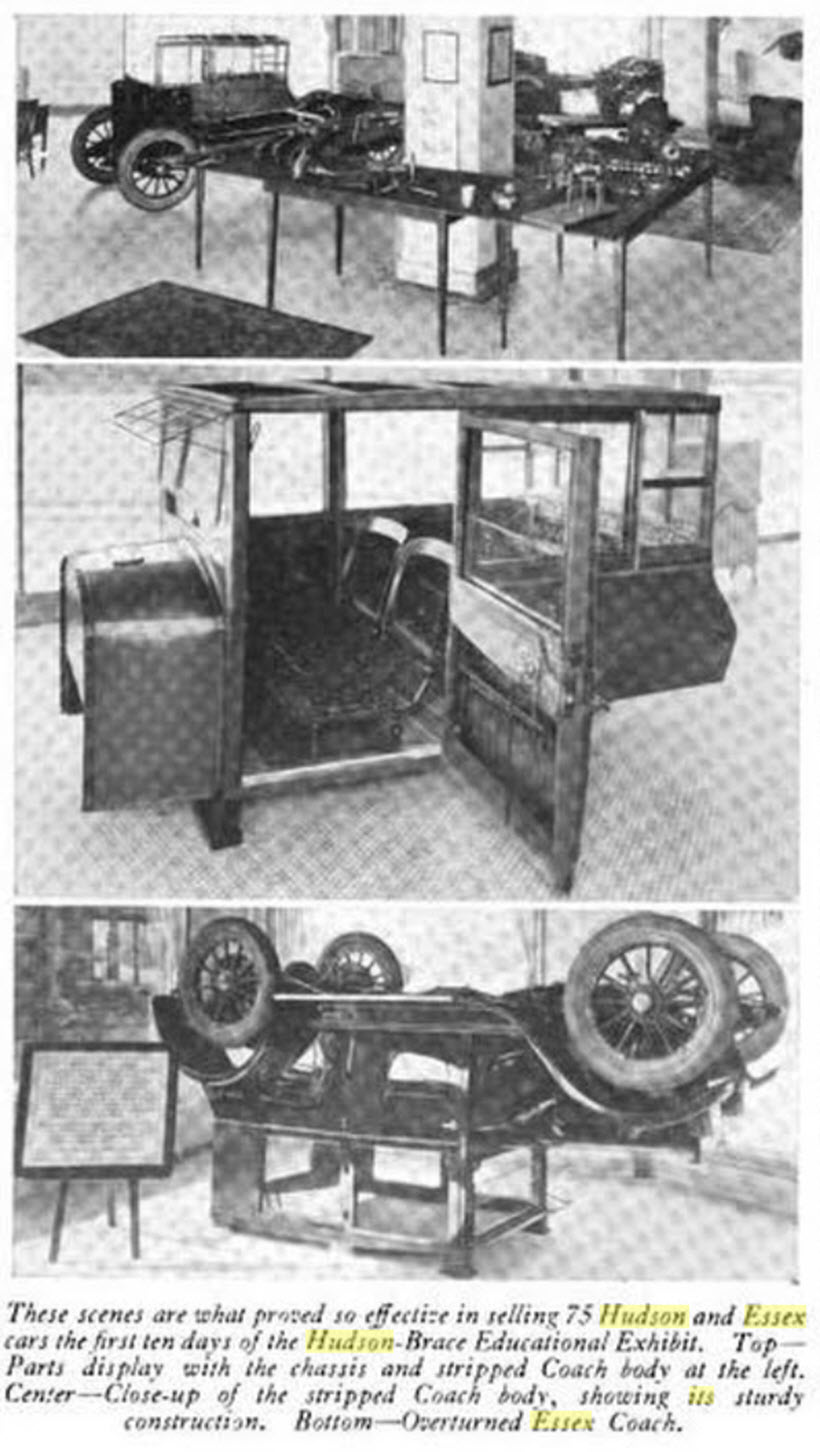
From The Hudson Triangle, Detroit Michigan, December 1, 1922.
Books

Related Resources


Copyright Notice

Reed Brothers Dodge History (1915-2012) by Jeanne Gartner is licensed under a Creative Commons Attribution-NonCommercial 3.0 Unported License.
 Reed Brothers Dodge History 1915 – 2012
Recent Comments