
1930-1940s
Reed Brothers Dodge Becomes Reed Brothers Dodge-Plymouth
The year after the stock market crash that began the Great Depression, few could afford to buy cars. Like most other businesses, the Great Depression hit auto sales hard, and many dealerships had to declare bankruptcy. Reed Brothers had to rely heavily on its service department to make ends meet, but the dealership survived through these lean times.
In 1930, Reed Brothers added the Plymouth line. The first Plymouth franchises (starting in 1928) were only available to Chrysler dealerships, but in 1930 they became available to Dodge and DeSoto dealers as well. With the addition of the Plymouth brand, Reed Brothers Dodge became Reed Brothers Dodge-Plymouth.
By the early 1930s Plymouth was among the top three highest-selling car brands in the nation alongside Ford and Chevrolet. In fact, Plymouth was the reason that Chrysler was able to survive the 1930s at all. Because Plymouths stayed at a low price throughout the lean times of the Depression, Chrysler was able to use their sales to pull through the economic downturn.
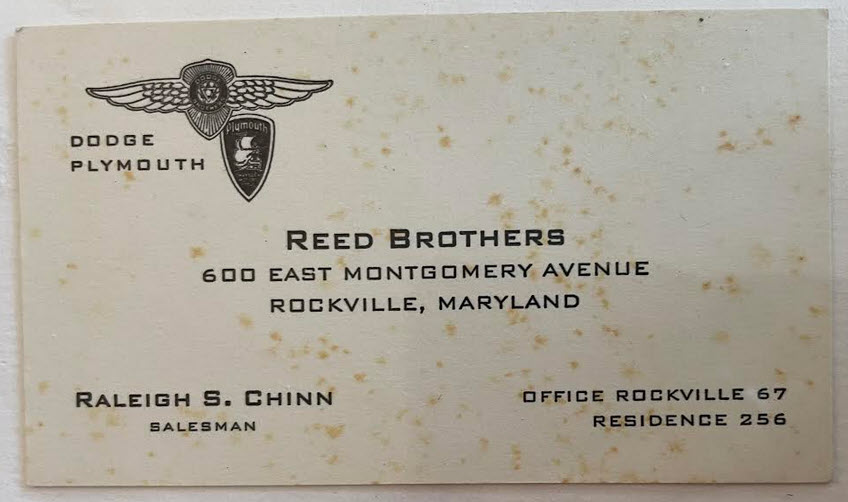
Salesman Raleigh Chinn’s business card, reflecting the addition of the Plymouth line after 1930.
Lewis Reed, an avid motorcycle enthusiast, also acquired and sold Harley-Davidson Motorcycles at his dealership. Between 1915 and 1950, Reed Brothers Dodge sold more than just cars. In addition to automobiles, the dealership also sold a wide variety of vehicles such as farm tractors, delivery trucks, firetrucks, school buses, and apparently, motorcycles.
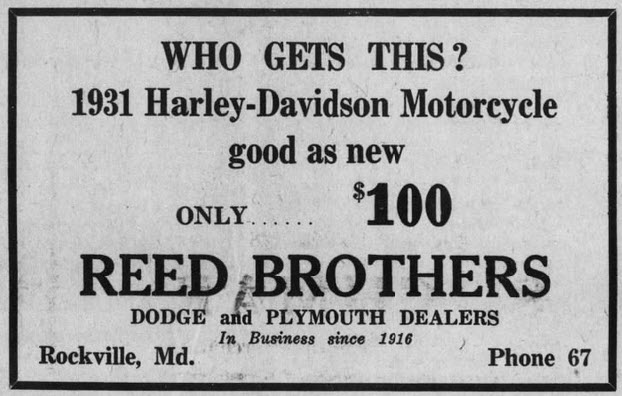
Montgomery County Sentinel, Feb 2, 1933
Apparently, living in the countryside of Montgomery County could be expensive. Gas prices reflected the remoteness of county life.
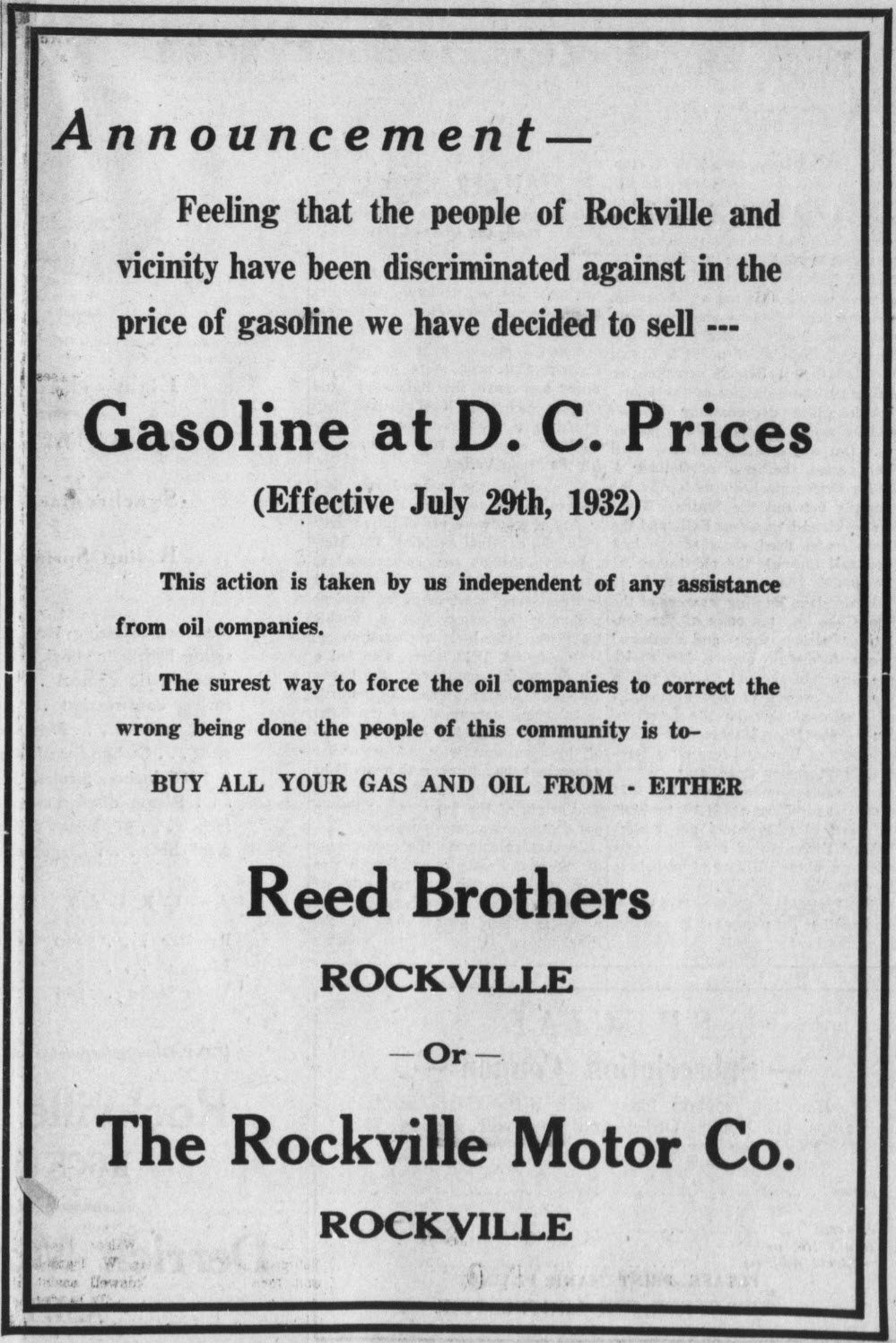
The companion article to the the ad below, which appeared in the Montgomery County Sentinel, July 29, 1932, claims Reed and Perry refused to pass the gouging prices on to their customers:
These two progressive business institutions announce that they are selling gasoline at D.C. prices, which is new to these two towns. For a long time, these communities have been discriminated against in that other sections have been able to buy gas at lower prices. This even though the gasoline companies maintain gas tanks right in these localities and have little haul to reach filling stations. The reduction in prices announced will be absorbed entirely by the local firm. They are receiving no assistance. Both Edgar Reed of Reed Brothers and O.H. Perry of the Rockville Motor Company state that they have exerted every possible effort to have the discrepancies righted to no avail, however, and they are meeting the condition with distinct loss to themselves.
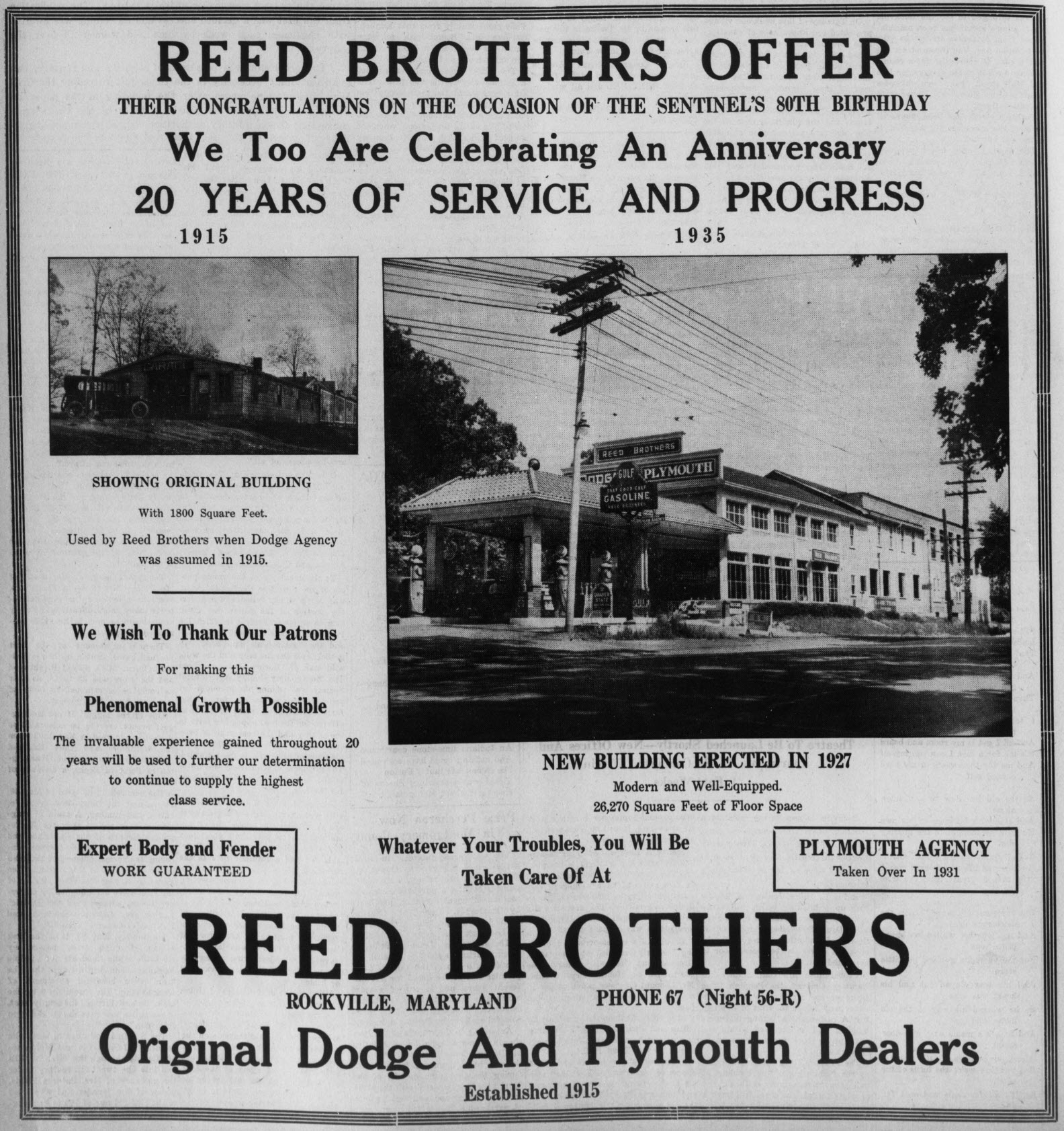
Reed Brothers celebrated its 20th anniversary, which coincided with the Montgomery County Sentinel‘s 80th anniversary in 1935.
Gulf Gas Station Remodel, 1939
Though the Depression years had been lean, Reed Brothers was still able to complete another extensive remodel, incorporating a brand-new version of its Gulf service station, along with newly painted offices and redecorated exterior of the building, reflecting a distinctly Art Deco style.
Below, is the newly-canopied full-service Gulf gas station at Reed Brothers. A closer look reveals the price of gasoline as 15 cents a gallon (and still advertising “D.C. Prices”). In addition to the Gulf signage there is a small, barely visible sign below that promotes “Clean Rest Rooms”– Gulf was the first oil company to promote public restrooms as a customer benefit.
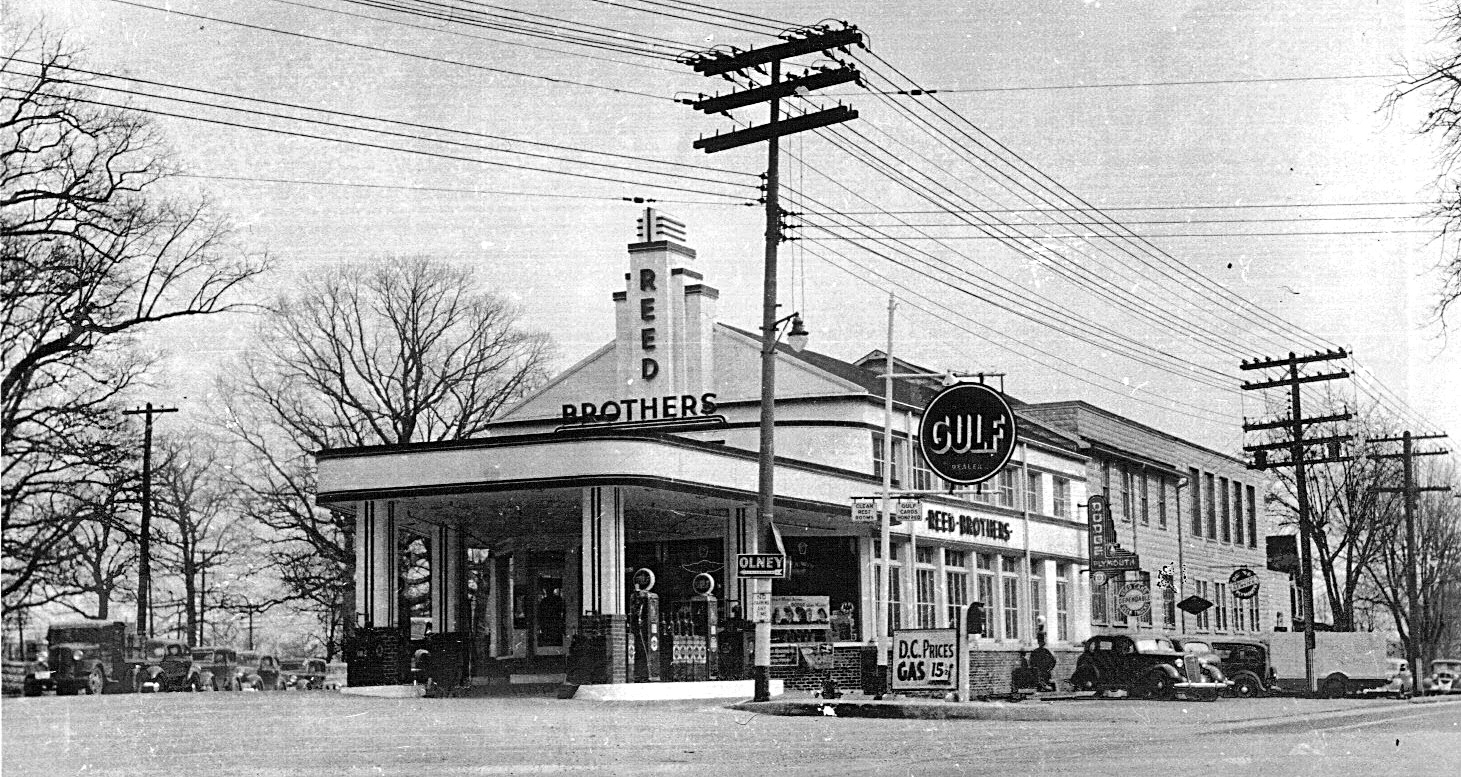
Gulf Gas Station Remodel, 1939
Silver Anniversary, 1940
The following year, Reed Brothers celebrated the 25th Anniversary of the founding of their automobile business. Presented by the Dodge Company to Edgar and Lewis Reed, co-partners in the business, the silver scroll displays the following inscription:
Know all men by these presents that Reed Brothers has, for 25 years remained in continuous business association with Dodge, in recognition whereof we have caused to be issued this 25th Anniversary token.
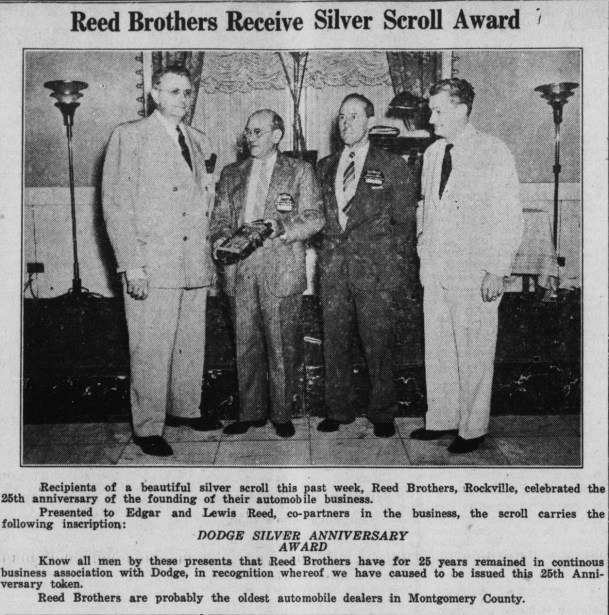
Montgomery County Sentinel, September 14, 1939

Edgar and Lewis Reed (center) receive Dodge Silver Anniversary Award
New Construction, 1941
Only a few years after the gas station remodel, the dealership was doing well enough to finance the construction of a new Showroom, Parts, and Service Department, completed in 1941. At that time, about eight new cars and trucks were being sold each month, along with a number of used car sales. As had been the custom for years in the automobile business, purchases were sometimes initiated at a prospect’s home or job site, rather than solely at the dealership. Lewis Reed allotted specific sales territory to his salesmen in four different directions from the dealership’s home base. The salesmen spent all day in the outlying areas because the farmers in Poolesville, Rockville, Barnesville, and Spencerville had no time to come into town to look around a showroom. Three of the four salesmen at the time were Francis O. Day, Raleigh S. Chinn, and Benjamin Thompson.

Montgomery County Sentinel, July 03, 1941

The new building formally opened on Saturday, July 5, 1941 and housed from 35-40 cars. The view is from the corner of Rockville Pike & Dodge Street, at the the back of the triangle-shaped property.
United States Enters World War II
Once the United States entered World War II in late 1941, Reed Brothers Dodge had almost no new cars to sell for three and a half years. Empty showrooms were a problem. Manufacturers halted car production and many dealers went bankrupt. Those that survived relied on their service and parts departments to fix the cars people couldn’t replace. But maintenance was also a problem because tires and parts were rationed. Strict price ceilings governed used car sales, and used cars were hard to find anyway because people could not afford to give them up.
Always the entrepreneur, Lewis Reed converted his car showroom into a display room and sold GE washing machines, Westinghouse radios, and other large appliances to bridge the gap.
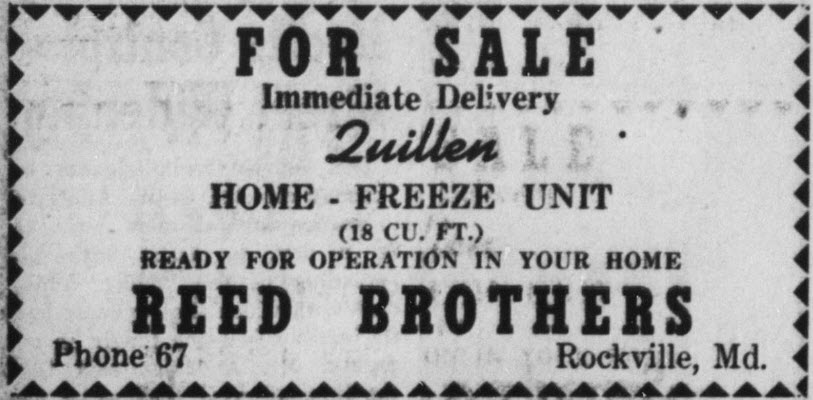
July 25, 1946 advertisement in the Sentinel for freeze units at Reed Brothers.
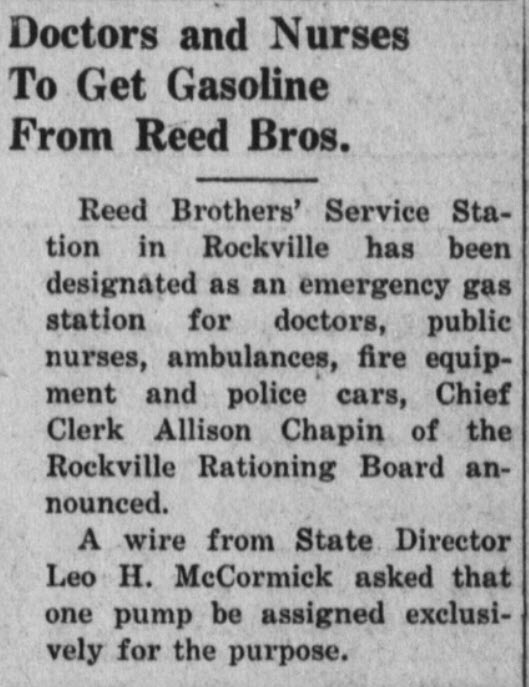
Sentinel, January 11, 1945
Gasoline Rationing in World War II
Americans who owned cars in the 1940s were also limited to the amount of gasoline they could buy due to rationing during World War II. Starting in early 1942, gasoline was deemed a precious commodity and, due to its limited supply, was needed to fuel planes, tanks, Jeeps, and boats for the war effort.
Upon approval of the Rockville Rationing Board, Reed Brothers’ Gulf Gasoline Station reserved one pump exclusively for the use of doctors, nurses, ambulances, fire equipment and police cars. The program continued until August 18, 1945.
The 1940s
This print ad from Reed Brothers placed in the September 30, 1943 issue of the Montgomery County Sentinel advertises their appointment as official Hudson service headquarters. The ad also takes us back to the patriotic era of World War II. In the center of the ad is, “Buy U.S. War Savings Stamps and Bonds”, reminding Americans of their duty to protect their country’s freedom, and encouraged them to support the war effort by buying savings bonds and stamps.
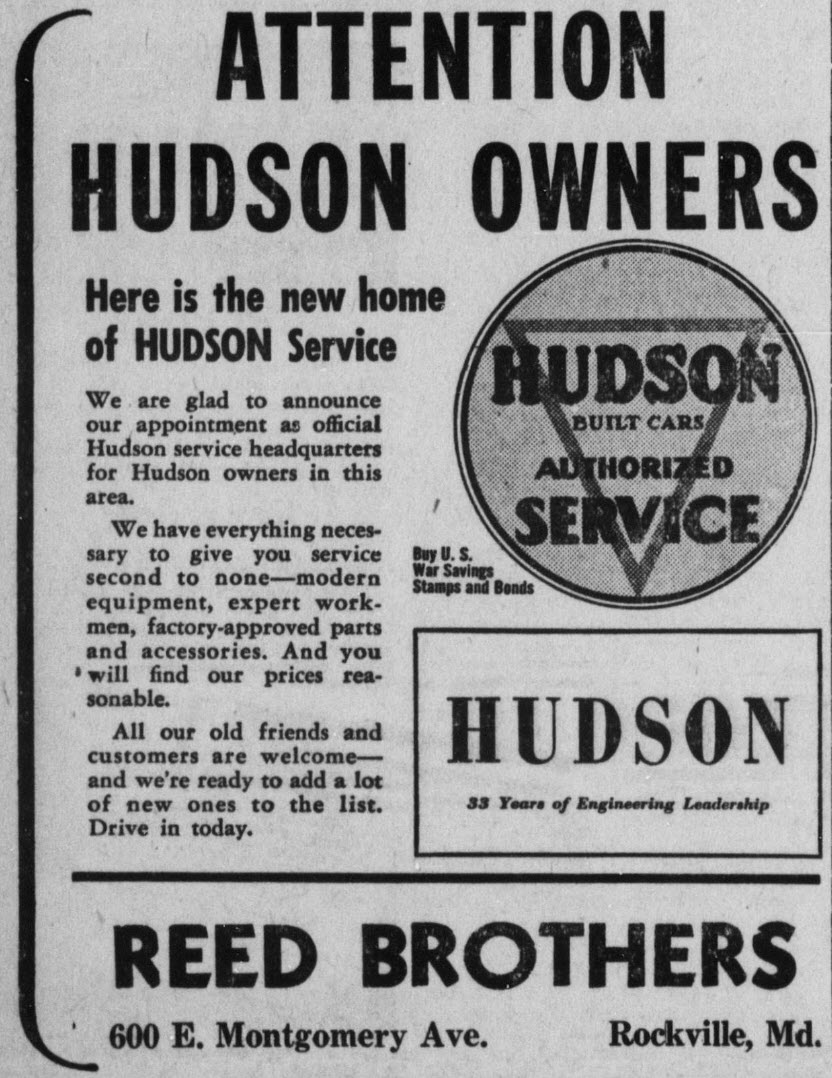
Montgomery County Sentinel. Sept 30, 1943
This Reed Brothers Dodge & Plymouth Service Invoice is dated June 28, 1944. $5.00 labor and 90 cents parts for a total of $5.90. The dealership’s address at the time was 600 East Montgomery Avenue Rockville. H.L. England’s name is on the invoice and his car was a 1941 Dodge Coupe.
Harrison L. England was active in land development of older Rockville, including Lincoln Park and Croydon Park. He was born in the building once known as Hungerford Tavern on N. Washington Street and operated a business under the name of Suburban Properties. His father was John G. England, the first mayor of Rockville.
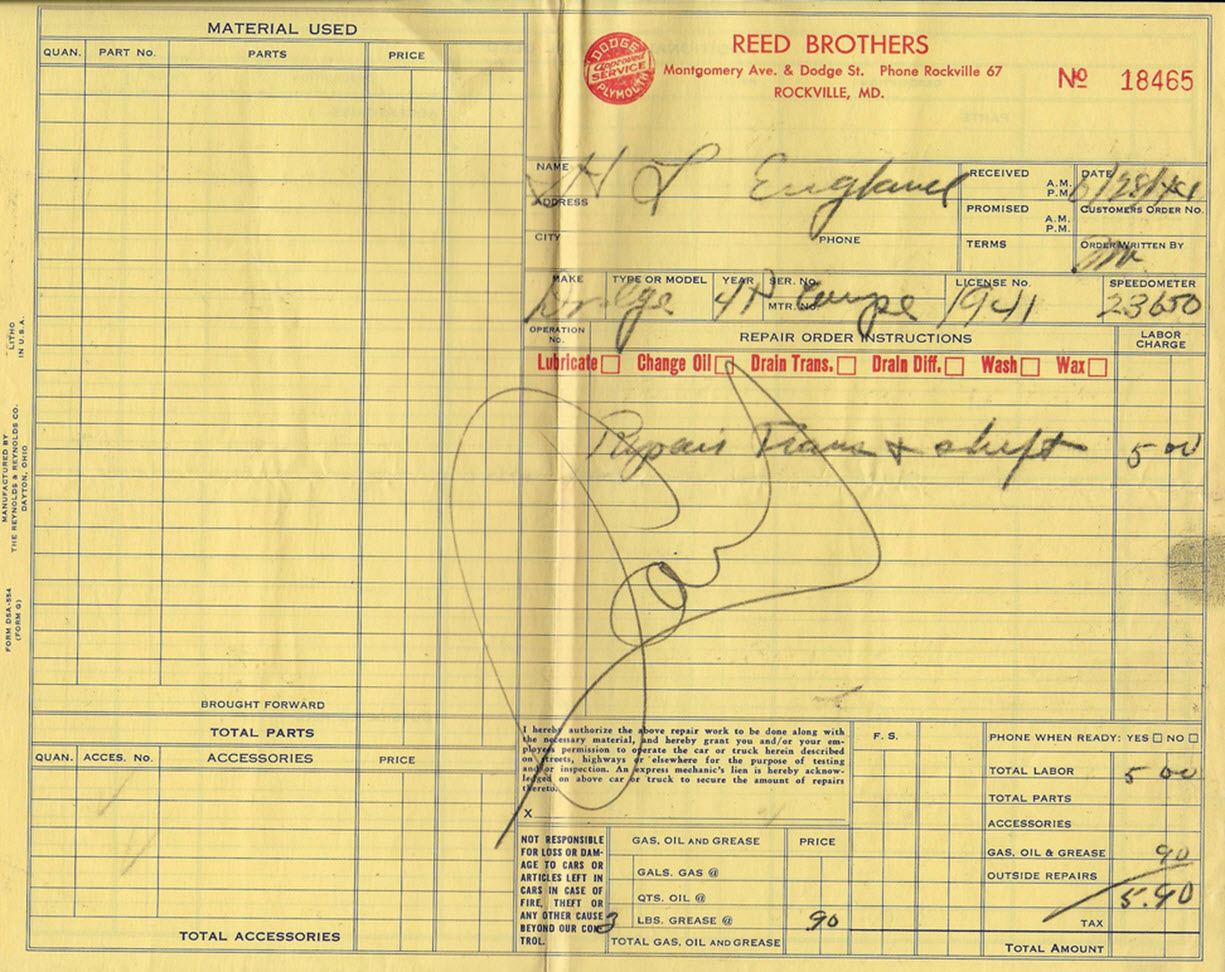
Reed Brothers Celebrates Its 30th Anniversary, 1945
”The name REED BROTHERS has become to the automobile public what the name “Sterling” is to silver.”
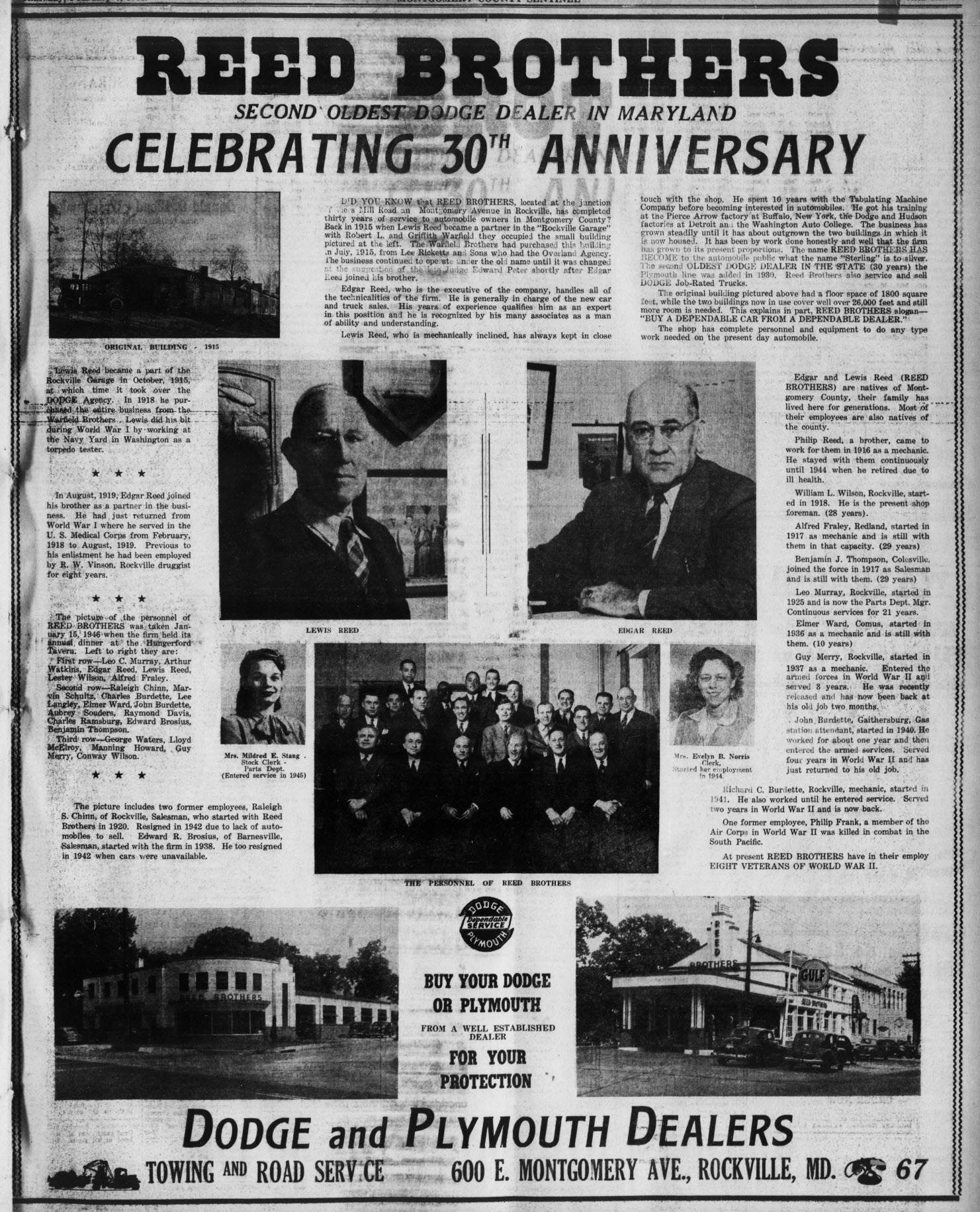
Full page article from The Montgomery County Sentinel. February 7, 1946
After the end of World War II, the car boom came, and the automobile assembly lines were back in action. The first car to arrive after the war was the 1946 Dodge, which sold for about $800. Ernest Lee Gartner (pictured), who married Lewis Reed’s daughter, Mary Jane, joined the business in 1949.
2 responses to “1930-1940s”
Leave a comment
Books

Recent Comments
 | Reed Brothers on From Chauffeur to Dodge D… |
| Reed Brothers on 90 Year Brouchure |
 | Anthony Belson on 90 Year Brouchure |
 | Michelle on From Chauffeur to Dodge D… |
 | ptkernan on Snapshots in Time: Reed Brothe… |
| Reed Brothers on Winter’s Harvest: Ice-Cutting… |
 | folksnake on Winter’s Harvest: Ice-Cutting… |
| References-Mapping… on Then & Now: Old Post Offic… | |
| Reed Brothers on The Dodge Brothers’ First Car… |
| ptkernan on The Dodge Brothers’ First Car… |
Related Resources


Copyright Notice

Reed Brothers Dodge History (1915-2012) by Jeanne Gartner is licensed under a Creative Commons Attribution-NonCommercial 3.0 Unported License.
 Reed Brothers Dodge History 1915 – 2012
Interesting history of a dealership loyal to the Dodge Bros Motor car Company, Wayne County Michigan. Owned and operated by John F. Dodge (1864-1925) and his brother, the mechanical genius Horace E. Dodge (1868-1925) sons of William C. Dodge, boilermaker, Niles, Michigan. My great grandfather’s uncle’s cousins were the Dodge Brothers who manufactured cars in Wayne County, Michigan. Their widows sold the company to Walter Chrysler in 1928. I am also related to Walter Chrysler. His original name was Walter Greisler. His ancestors came from the Schwabian Crescent during the eighteenth century German Republic. They were farmers who settled during the nineteenth century in the Ottawa Valley of Upper Canada. Walter Chrysler was a railroad worker who became president of the Buick Division of General Motors Company, Detroit, Michigan. He built the Chrysler Building in New York City. It was, at one time, the tallest building in USA. And It’s owner was one of the wealthiest men in the world.
Richard Dodge Jr
Hello Richard, Thanks so much for stopping by and taking the time to share your fascinating background and family history. Your association with the Dodge Brothers and Walter Chrysler is wonderful! It always makes me happy to learn new information. Thanks again for sharing!
My Best Regards,
Jeanne